Navigating the complexities of dental insurance, especially when considering significant procedures like dental implants, can feel overwhelming. Many individuals in Dallas find themselves wondering whether their PPO or HMO plan offers sufficient coverage to make these life-changing tooth replacement options accessible. In 2026, understanding the nuances of PPO vs. HMO Dental Implant Coverage Dallas: Maximizing Benefits and Avoiding Surprises is more critical than ever. This guide aims to provide clear, medically responsible information to help Dallas residents make informed decisions about their long-term oral health.
Dental implants represent a significant investment in both oral health and overall well-being. They offer a durable and aesthetically pleasing solution for missing teeth, closely mimicking natural teeth. However, the cost can be a barrier without proper insurance navigation. This article will break down how PPO (Preferred Provider Organization) and HMO (Health Maintenance Organization) plans typically handle dental implant coverage in Dallas, focusing on strategies to maximize your benefits and steer clear of unexpected expenses.
Key Takeaways
- PPO vs. HMO: Fundamental Differences: PPO plans offer more flexibility in choosing providers, including out-of-network options, while HMO plans require you to select a primary care dentist within a specific network and often need referrals for specialists.
- Coverage for Dental Implants: Both PPO and HMO plans may offer some coverage for dental implants, but it’s rarely 100%. Coverage often falls under major restorative procedures and can vary significantly by plan.
- Pre-Authorization is Crucial: Always obtain pre-authorization from your insurance provider before starting any dental implant procedure to understand your exact coverage and out-of-pocket costs.
- Understanding Cost Factors: Be aware of deductibles, annual maximums, co-insurance, and waiting periods, as these greatly impact your final expenses for dental implants in Dallas.
- Local Expertise Matters: Consulting with a Dallas dental implant clinic experienced in working with various insurance plans can help you navigate the process effectively.
PPO vs. HMO Dental Implant Coverage Dallas: Understanding Your Options in 2026
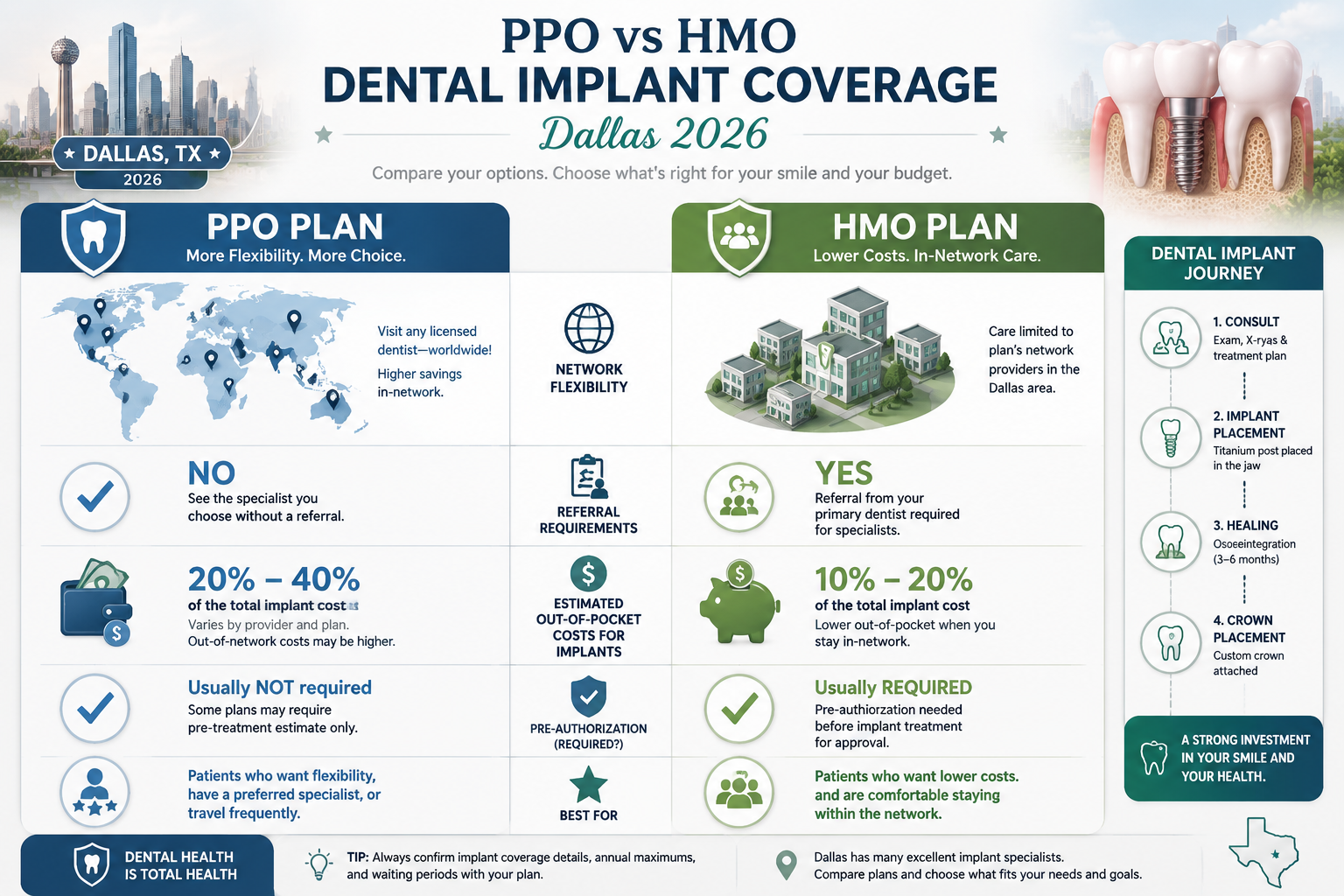
When considering dental implants in Dallas, one of the first steps is to understand how your dental insurance plan works. The two most common types of dental insurance plans are PPO and HMO, and their approach to covering advanced procedures like dental implants differs significantly.
PPO Dental Plans: Flexibility and Choice
PPO plans are known for their flexibility. With a PPO, you typically have the freedom to choose any licensed dentist, whether they are in-network or out-of-network. While you can visit out-of-network dentists, your out-of-pocket costs will generally be higher, as the plan covers a larger percentage of costs for in-network providers.
For dental implants, PPO plans often categorize them as a “major restorative procedure.” This usually means the plan covers a certain percentage of the cost after your deductible has been met, up to an annual maximum. The coverage percentage for major procedures can range from 30% to 70%, depending on your specific plan.
Key Features of PPO Plans for Dental Implants:
- Provider Choice: Wide selection of dentists and specialists.
- No Referrals: Generally, you do not need a referral to see a specialist, such as an oral surgeon or periodontist, for your implant surgery process.
- Higher Premiums: Typically, PPO plans have higher monthly premiums compared to HMO plans.
- Deductibles & Co-insurance: You’ll likely pay a deductible before coverage kicks in, and then a percentage of the cost (co-insurance) for the procedure.
- Annual Maximums: There’s usually a cap on the total amount your insurance will pay in a calendar year. For extensive procedures like dental implants, it’s common to exceed this maximum, meaning you’ll pay the remainder out-of-pocket.
Example Scenario (PPO, 2026):
Let’s say a dental implant procedure in Dallas costs $4,000. Your PPO plan has a $50 deductible and covers 50% of major procedures, with an annual maximum of $1,500.
- Deductible: You pay the first $50.
- Remaining Cost: $4,000 – $50 = $3,950.
- Insurance Pays 50%: 50% of $3,950 = $1,975.
- Applied to Maximum: Since $1,975 is more than the $1,500 annual maximum, the insurance will only pay $1,500.
- Your Out-of-Pocket: $4,000 – $1,500 (insurance payment) = $2,500.
It’s important to note that the implant cost in Dallas can vary based on factors such as the complexity of the case, the specific type of implant (e.g., Titanium vs Zirconia Dental Implants in Dallas 2026), and additional procedures like bone grafting or extractions. For those with PPO plans, understanding Qualifying for Dental Implant Insurance Reimbursement Dallas can unlock further benefits.

HMO Dental Plans: Managed Care and Cost Efficiency
HMO plans, also known as Dental Health Maintenance Organizations (DHMOs), operate differently. These plans typically require you to choose a primary care dentist within a specific network. To see a specialist, such as an oral surgeon for your dental implant procedure, you almost always need a referral from your primary care dentist.
HMOs are generally more cost-effective in terms of monthly premiums. Instead of paying a percentage, you often pay a fixed co-payment for services. However, this cost efficiency comes with less flexibility in provider choice. If you choose an out-of-network dentist, the plan usually won’t cover any costs, making your entire procedure an out-of-pocket expense.
Key Features of HMO Plans for Dental Implants:
- Limited Provider Network: Must choose a dentist from the plan’s specific network.
- Referrals Required: A referral is typically needed to see a specialist for implant surgery.
- Lower Premiums: Generally, HMO plans have lower monthly premiums.
- Fixed Co-payments: You pay a set fee for services, rather than a percentage.
- No Annual Maximums (Sometimes): Some HMO plans may not have annual maximums, but they often have limitations on the number of covered procedures or specific conditions for coverage.
- Strict Guidelines: Coverage for dental implants may be more restrictive, often requiring the procedure to be deemed medically necessary.
Example Scenario (HMO, 2026):
Consider the same $4,000 dental implant procedure. Your HMO plan has a fixed co-payment of $1,500 for a dental implant.
- Referral: You must first obtain a referral from your in-network primary care dentist to an in-network oral surgeon.
- Co-payment: You pay the fixed co-payment of $1,500 directly to the provider.
- Insurance Covers: The insurance plan covers the remaining $2,500.
- Your Out-of-Pocket: $1,500.
For Dallas residents exploring all tooth replacement options, it’s beneficial to compare these plans with other avenues, such as Employer Dental Insurance for Implants Dallas 2026 or even understanding if Medicare Advantage Plans Dallas 2026 offer any implant benefits.
Maximizing Your Dental Implant Benefits with PPO vs. HMO Dental Implant Coverage Dallas in 2026
Regardless of whether you have a PPO or HMO plan, strategic planning is essential to maximize your benefits and avoid surprises when pursuing dental implants in Dallas.
The Importance of Pre-Authorization
Pre-authorization (or pre-determination) is perhaps the most critical step. This involves your dentist submitting your proposed treatment plan to your insurance company before starting the dental implant procedure. The insurer will review the plan and inform you (and your dentist) exactly what they will cover, how much they will pay, and what your out-of-pocket expenses will be.
Why Pre-Authorization is Crucial:
- Clarity on Coverage: Eliminates guesswork regarding what procedures are covered and at what percentage.
- Cost Transparency: Provides a clear estimate of your financial responsibility, preventing unexpected bills.
- Avoid Denials: Ensures that the treatment meets the insurance company’s specific criteria for coverage.
- Peace of Mind: Allows you to proceed with the dental implant procedure confidently, knowing your financial obligations.
Even with a pre-authorization, remember that it’s an estimate, not a guarantee of payment. However, it’s the best tool for understanding your benefits. A reputable clinic for dental implants in Dallas will assist you with this process.

Navigating Network Restrictions (HMO)
For HMO plans, adhering strictly to the network is paramount. If your chosen Dallas dentist or oral surgeon is not in your plan’s network, your coverage will likely be zero.
- Verify Network Status: Always confirm that both your general dentist and any specialists (oral surgeons, periodontists) are in your HMO network before scheduling appointments.
- Obtain Referrals: Ensure your primary care dentist provides the necessary referral for any specialized dental implant work. Without it, your claim will likely be denied.
Understanding Deductibles, Co-insurance, and Annual Maximums (PPO)
PPO plan holders need to be acutely aware of their financial responsibilities:
- Deductible: This is the amount you must pay out-of-pocket before your insurance begins to cover costs. Most plans have an individual and a family deductible.
- Co-insurance: Once your deductible is met, co-insurance is the percentage of the cost you are responsible for. For dental implants, this can range significantly.
- Annual Maximum: This is the absolute maximum amount your insurance company will pay for your dental care within a plan year. For extensive work like dental implants, it’s common for the total cost to exceed this maximum. You will be responsible for any costs beyond this limit.
Strategies to Consider:
- Staggering Treatment: If your annual maximum is a concern, and your treatment allows, discuss with your dentist the possibility of staggering parts of the dental implant procedure across two calendar years. For instance, the implant surgery process could be completed in late 2026, and the placement of the crown in early 2027, allowing you to utilize two separate annual maximums.
- Payment Plans: Many dental implant clinics in Dallas offer payment plans or financing options to help manage the out-of-pocket expenses.
- Health Savings Accounts (HSAs) or Flexible Spending Accounts (FSAs): If you have an HSA or FSA, these accounts can be excellent tools for paying for dental implant costs with pre-tax dollars.
Avoiding Surprises: Essential Tips for Dental Implant Coverage in Dallas 2026

Forewarned is forearmed when it comes to significant healthcare investments like dental implants. Proactive steps can save you considerable stress and expense.
Read Your Policy Carefully
The single most important piece of advice is to thoroughly read and understand your specific dental insurance policy. Insurance plans, even within the same PPO or HMO categories, can vary widely in their coverage for dental implants. Pay close attention to:
- Exclusions: Some policies explicitly exclude coverage for dental implants.
- Limitations: Look for limits on the number of implants covered or specific types of materials.
- Waiting Periods: Many plans have waiting periods (e.g., 6 months to 1 year) for major restorative procedures like dental implants. Ensure you meet these requirements.
- Downgrade Clauses: Some plans may “downgrade” coverage, meaning they will only pay for the cheapest alternative treatment (like a bridge), even if an implant is recommended. You would pay the difference.
Ask Your Dental Provider the Right Questions
During your consultation with a dentist in Dallas, be prepared with questions about costs and insurance.
- Cost Breakdown: Ask for a detailed, itemized cost breakdown of the entire dental implant procedure, including the implant post, abutment, and crown. Also inquire about any potential additional procedures, like Sinus Lift & Bone Graft Necessity in Dallas.
- Insurance Coordination: Inquire if the clinic has a dedicated insurance coordinator who can help you navigate the claims process and understand your benefits.
- Payment Options: Discuss available payment plans or financing options the clinic offers.
Remember, patient safety and long-term oral health are paramount. A transparent clinic will be happy to provide all the information you need to make an informed decision about missing teeth solutions.

Consider Other Financial Avenues
Even with insurance, a portion of the dental implant cost in Dallas will likely be out-of-pocket. Explore all available avenues:
- Dental Schools: Sometimes dental schools offer procedures at a reduced cost, though this often involves longer appointment times.
- Third-Party Financing: Companies specialize in healthcare financing, offering loans with various interest rates and payment terms.
- Negotiate Cash Discounts: Some dental practices may offer a discount for patients who pay in full with cash.
By taking these steps, Dallas residents can navigate the complexities of PPO vs. HMO dental implant coverage in 2026 more confidently, reducing financial surprises and ensuring access to quality tooth replacement options for optimal oral health education and care.
Conclusion
Understanding PPO vs. HMO Dental Implant Coverage Dallas: Maximizing Benefits and Avoiding Surprises in 2026 is a crucial step for anyone considering dental implants. While both plan types can offer some level of coverage, their structures—PPO’s flexibility with higher out-of-pocket costs versus HMO’s network restrictions with potentially lower fixed costs—demand careful consideration. The key to maximizing your benefits lies in proactive research, meticulous pre-authorization, and clear communication with both your insurance provider and your chosen Dallas dental implant professional.
By fully understanding your policy’s specifics, asking the right questions during your consultation with a dentist, and exploring all available financial avenues, you can approach your dental implant procedure with confidence and peace of mind. Prioritizing patient safety and long-term oral health through informed decision-making is the best strategy for achieving a successful and financially manageable outcome for your dental implants in Dallas.
Actionable Next Steps:
- Review Your Policy: Get a copy of your dental insurance policy and thoroughly read the sections on “major restorative procedures” or “dental implants.”
- Contact Your Insurer: Call your insurance provider directly to confirm your benefits, deductibles, annual maximums, waiting periods, and pre-authorization requirements for dental implants.
- Schedule a Consultation: Book a consultation with a reputable Dallas dental implant clinic. Be prepared with your insurance information and a list of questions about the procedure, costs, and payment options. Ask them to assist with pre-authorization.
- Get an Itemized Estimate: Request a detailed, written estimate for all anticipated costs associated with your dental implant treatment.