Are you considering dental implants to restore your smile and chewing function? If you’re missing two adjacent teeth or need support for a small bridge, the “cost of 2 dental implants” is likely a top concern. I understand that investing in your oral health is a big decision, and navigating the financial aspects can feel overwhelming. That’s why I’ve put together this comprehensive guide for 2025, to break down exactly what you can expect when it comes to the price tag of restoring your smile with two dental implants.
Dental implants are a revolutionary solution, offering a permanent and natural-looking replacement for missing teeth. Unlike dentures or traditional bridges, implants integrate directly with your jawbone, providing unmatched stability and preserving your bone structure. But what does this advanced solution truly cost, especially when you need two of them? Let’s dive deep into the factors, procedures, and financing options available to you in 2025.
Read Also:-Unlocking Your Smile: What’s the Average Cost of Dental Implants for Dentures in 2025?
Key Takeaways
- The “cost of 2 dental implants” in 2025 can range significantly, typically from $6,000 to over $25,000, depending on various factors and whether preliminary procedures are needed.
- This cost often includes the implant post, abutment, and the final restoration (two individual crowns or an implant-supported bridge).
- Key factors influencing the price include your geographic location, the dentist’s experience, the type of materials used, and crucial preliminary procedures like bone grafting or tooth extractions.
- While dental insurance often provides limited coverage, various financing options such as payment plans, HSAs, and FSAs can make dental implants more affordable.
- Always seek a detailed, itemized cost breakdown from your dental professional to understand all components of your personalized treatment plan.
What Exactly Are Dental Implants? A Quick Refresher
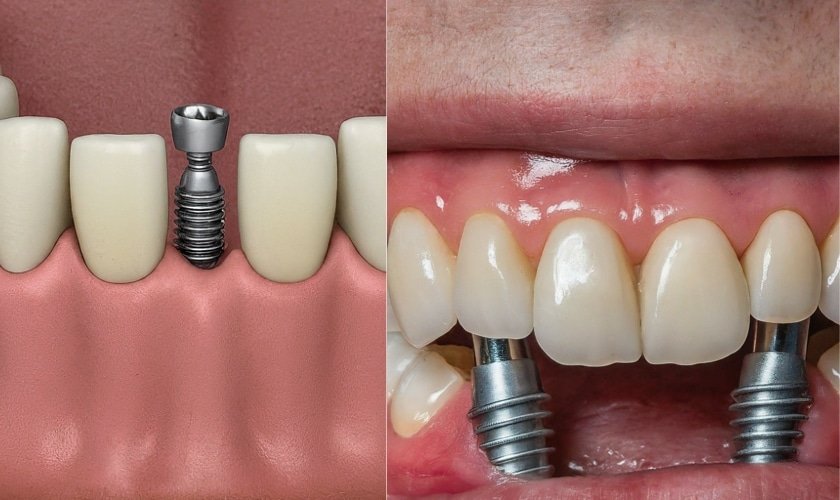
Before we delve into the numbers, let’s quickly review what dental implants are. Think of a dental implant as an artificial tooth root, usually made of titanium, that is surgically placed into your jawbone. This post then fuses with the bone over several months – a process called osseointegration – creating a strong, stable foundation.
Once the implant is secure, a small connector piece called an abutment is attached to it. Finally, a custom-made dental crown (which looks and feels like a natural tooth) is placed on top of the abutment. The result? A fully functional, aesthetically pleasing tooth replacement that can last a lifetime.
When we talk about the “cost of 2 dental implants,” we’re generally referring to two separate implant posts, two abutments, and two individual crowns to replace two missing teeth. However, two implants can also be used to support a three-unit (or even four-unit) implant-supported bridge, which replaces three or four missing teeth by anchoring them to just two implants. This is a common and often cost-effective solution for multiple missing teeth in a row.
Understanding the “Cost of 2 Dental Implants”: It’s Not a Single Number 📊
One of the most important things I want you to understand is that there isn’t a fixed price tag for two dental implants. The cost is highly variable and depends on a multitude of factors, making it challenging to give you an exact figure without a personalized consultation. However, I can provide you with a realistic range and explain what contributes to the variations.
Generally, in 2025, the cost for two individual dental implants, including the surgical placement, abutments, and two separate crowns, can range anywhere from $6,000 to $15,000 or more. This range is for straightforward cases without significant preparatory procedures. If preliminary treatments like bone grafting or extractions are needed, the total cost could easily climb to $10,000 to $25,000+.
“The price of two dental implants isn’t a fixed tag; it’s a dynamic figure shaped by many factors, from the complexity of your case to your geographic location.”
Let’s break down these factors to give you a clearer picture of what influences the overall investment.
Factors That Influence the Cost of Two Dental Implants 🌎🧑⚕️🦷
Several key elements come into play when determining the final cost of your dental implant procedure. Understanding these can help you anticipate expenses and ask the right questions during your consultation.
1. Geographic Location 📍
Just like real estate, dental costs can vary significantly based on where you live. Major metropolitan areas or regions with a higher cost of living tend to have higher prices for dental procedures compared to rural areas. For example, dental implant costs in New York City or Los Angeles might be higher than in a smaller town in the Midwest. This is due to overhead costs, rent, staff salaries, and regional economic factors.
2. Dentist’s Experience and Specialization 👩⚕️👨⚕️
The expertise of your dental professional plays a crucial role in both the success of your implants and the cost. An oral surgeon or periodontist, who specializes in implant placement, might charge more than a general dentist who also performs implant procedures. Their specialized training, advanced equipment, and extensive experience are valuable assets that contribute to their fees. Think of it as paying for peace of mind and optimal results.
3. Type of Implant Material and Brand 🔩
Dental implants are typically made from either titanium or zirconia.
- Titanium implants are the most common and have a long, proven track record of success. They are strong, biocompatible, and integrate well with bone.
- Zirconia implants are a newer, metal-free alternative, often chosen by individuals with metal allergies or those who prefer a holistic approach. They can sometimes be more expensive.
Beyond the material, there are various implant brands (e.g., Straumann, Nobel Biocare, Zimmer Biomet). Premium brands, which invest heavily in research and development, often come with a higher price tag but may offer advanced designs and better long-term reliability.
4. Number of Implants and Type of Restoration 🦷🦷
While our focus is on the “cost of 2 dental implants,” it’s important to differentiate how those two implants will be used:
- Two Individual Implants with Two Crowns: This is the most straightforward scenario for replacing two adjacent missing teeth. Each implant receives its own abutment and crown. This typically involves paying for two full implant systems.
- Two Implants Supporting an Implant-Supported Bridge: If you’re missing three or four teeth in a row, two implants can serve as anchors for a bridge. In this case, you’re paying for two implants but one larger restoration (the bridge) instead of two individual crowns. The cost of a three-unit bridge can sometimes be comparable to or even slightly less than two individual crowns, depending on the materials and lab fees.
5. Preliminary Procedures: Often the Hidden Costs 🤫
This is where the cost can truly fluctuate. Many patients require additional procedures before the implants can be placed successfully. These are essential for ensuring the long-term stability and success of your implants.
- Initial Consultation & Diagnostics: This includes X-rays, 3D CT scans (Cone Beam Computed Tomography – CBCT), and a thorough examination to assess your oral health, bone density, and plan the implant placement. These diagnostic tools are crucial for precision and can cost anywhere from $100 to $500.
- Tooth Extractions: If you have damaged or decaying teeth that need to be removed before implant placement, this will be an additional cost. A simple extraction might be $75-$300, while a surgical extraction can range from $200-$600 per tooth.
- Bone Grafting: If your jawbone isn’t thick or dense enough to support the implants, a bone graft is necessary. This procedure adds bone material (from your own body, a donor, or synthetic sources) to strengthen the implant site. Bone grafting costs vary widely depending on the extent and type of graft, from $250 for a minor graft to $3,000 or more for complex cases per site.
- Sinus Lift: If implants are needed in the upper jaw and the sinus cavity is too close to the jawbone, a sinus lift procedure might be required. This involves gently lifting the sinus membrane and placing bone graft material to create sufficient bone height. A sinus lift can cost between $1,500 and $3,000 per side.
- Gum Disease Treatment: If you have active gum disease, it must be treated and controlled before implant placement to ensure a healthy environment for the implants. This could involve deep cleaning (scaling and root planing) or more advanced periodontal procedures.
6. Anesthesia Options 😴
The type of anesthesia used during your implant surgery will also affect the cost.
- Local anesthesia (numbing the area) is typically included or has minimal additional cost.
- Sedation dentistry (oral sedation, nitrous oxide, or IV sedation) offers a more relaxed experience but comes with an extra fee, often ranging from $300 to $1,000 or more per appointment, depending on the duration and type of sedation.
- General anesthesia (being completely asleep) is less common for single or dual implant placement but is available for highly anxious patients or complex cases, and it’s the most expensive option.
7. Laboratory Fees 🧪
The custom-made abutments and crowns (or bridge) are fabricated in a dental lab. These fees vary based on the materials used (e.g., porcelain-fused-to-metal, all-ceramic, zirconia) and the complexity of the restoration. High-quality, aesthetic restorations require skilled technicians and premium materials, which contribute to the overall price.
8. Follow-up Appointments and Maintenance 📅
While often included in the overall package, ensure you understand if post-operative check-ups, implant care instructions, and any necessary adjustments are covered. Long-term maintenance, including regular cleanings and check-ups, is crucial for the longevity of your implants, but these are typically part of your routine dental care and not specific to the implant cost itself.
A Detailed Breakdown: What You’re Paying For (Estimated Costs for 2025) 💰
Let’s break down the individual components of the “cost of 2 dental implants” to give you a clearer picture. Please remember these are estimated ranges for 2025 and can fluctuate significantly based on the factors I’ve already discussed.
| Procedure Component | Estimated Cost Per Implant (2025) | Estimated Cost for TWO Implants (2025) | Notes
Initial Consultation & Imaging: ~$100 – $500
Tooth Extraction (if needed): ~$75 – $600 per tooth
Bone Grafting (if needed): ~$250 – $3,000+ per site
Sinus Lift (if needed): ~$1,500 – $3,000 per side
Dental Implant Fixture (the post): ~$1,000 – $3,000 per implant
Abutment (connector piece): ~$300 – $1,000 per implant
Dental Crown (final tooth): ~$1,000 – $3,000 per crown
Surgical Placement (of implant): ~$500 – $2,000 per implant
Anesthesia (sedation): ~$300 – $1,000+ per session
Scenario 1: Two Individual Implants with No Complications
This is a best-case scenario where you have sufficient bone and no extractions are needed.
- 2 x Implant Fixture: $2,000 – $6,000
- 2 x Abutment: $600 – $2,000
- 2 x Dental Crown: $2,000 – $6,000
- 2 x Surgical Placement: $1,000 – $4,000
- Initial Consultation/Diagnostics: $100 – $500
- Estimated Total: $5,700 – $18,500
As you can see, even without complications, the range is broad. A realistic average for two individual implants in a good-quality practice might be around $9,000 – $13,000 for the implant, abutment, and crown components.
Scenario 2: Two Implants Supporting a 3-Unit Bridge (No Complications)
Here, two implants support three missing teeth.
- 2 x Implant Fixture: $2,000 – $6,000
- 2 x Abutment: $600 – $2,000
- 1 x 3-Unit Implant-Supported Bridge: $3,000 – $7,000 (can vary based on materials and complexity)
- 2 x Surgical Placement: $1,000 – $4,000
- Initial Consultation/Diagnostics: $100 – $500
- Estimated Total: $6,700 – $19,500
The cost for a 3-unit bridge can sometimes be slightly more or less than two individual crowns, depending on the lab fees and materials.
Scenario 3: Two Individual Implants with Preliminary Procedures
This is a more common scenario, where you might need an extraction and bone graft for each implant site.
- 2 x Implant Fixture: $2,000 – $6,000
- 2 x Abutment: $600 – $2,000
- 2 x Dental Crown: $2,000 – $6,000
- 2 x Surgical Placement: $1,000 – $4,000
- Initial Consultation/Diagnostics: $100 – $500
- 2 x Tooth Extraction: $150 – $1,200
- 2 x Bone Grafting: $500 – $6,000 (depending on complexity and material)
- Anesthesia (sedation): $300 – $1,000
- Estimated Total: $6,650 – $26,700+
As you can see, preliminary procedures significantly impact the final cost. It’s crucial to get an itemized treatment plan from your dentist that clearly outlines all anticipated costs. Don’t be shy about asking for this!
Comparing Options: Two Individual Implants vs. An Implant-Supported Bridge 🤔
When you’re missing two or more teeth in a row, you often have a choice: two individual dental implants or an implant-supported bridge anchored by two implants.
Two Individual Implants
- Description: Each missing tooth is replaced with its own implant, abutment, and crown.
- Pros:
- Treats each tooth independently, allowing for easier flossing and cleaning between teeth.
- If one implant has an issue, it doesn’t necessarily affect the other.
- Provides maximum bone stimulation at each site, preserving jawbone.
- Cons:
- Generally a higher total cost than an implant-supported bridge if replacing three or more teeth.
- Requires more surgical sites if replacing multiple adjacent teeth.
- Best for: Replacing two adjacent teeth, or when teeth on either side of a larger gap are healthy and don’t need to be part of a bridge.
Implant-Supported Bridge
- Description: Two dental implants are placed (one at each end of the gap), and these implants support a bridge that spans the gap, replacing three or four teeth.
- Pros:
- Can be a more cost-effective solution than three or four individual implants.
- Fewer surgical sites compared to replacing every missing tooth with an implant.
- Strong and stable, preventing adjacent teeth from shifting.
- Cons:
- Requires more meticulous cleaning under the bridge.
- If one implant has an issue, it could affect the entire bridge.
- The middle tooth/teeth of the bridge do not directly stimulate the jawbone underneath, potentially leading to some localized bone loss over a very long time.
- Best for: Replacing three or four missing teeth in a row when the bone quality at the ends of the gap is good enough to support the implants.
“Choosing between two individual implants and an implant-supported bridge involves weighing both clinical needs and financial considerations. Your dentist will help you determine the most suitable option for your unique situation.”
Your dentist will evaluate your specific situation, bone health, and aesthetic goals to recommend the best treatment plan. Don’t hesitate to discuss both options and their respective costs and benefits.
Are Dental Implants Worth the Investment? Absolutely! 👍
Given the costs, you might be asking yourself, “Is this truly worth it?” From my perspective, and that of countless satisfied patients, the answer is a resounding YES. Dental implants are a long-term investment in your health, comfort, and quality of life.
Here’s why they are considered the gold standard for tooth replacement:
- Longevity: Unlike traditional bridges or dentures that often need replacement every 5-15 years, dental implants can last a lifetime with proper care. This makes them incredibly cost-effective in the long run.
- Improved Oral Health: Implants don’t require grinding down adjacent healthy teeth, as traditional bridges do. They also prevent bone loss in the jaw, which can occur when teeth are missing, preserving your facial structure.
- Natural Look and Feel: Implants look, feel, and function just like your natural teeth. You won’t experience the slipping, clicking, or discomfort often associated with dentures.
- Enhanced Chewing Ability: With implants, you can eat your favorite foods with confidence and comfort, without worrying about limitations. This greatly improves digestion and overall nutrition.
- Speech Improvement: Missing teeth or ill-fitting dentures can affect your speech. Implants restore clear and natural speaking patterns.
- Boosted Confidence: A full, beautiful smile can significantly improve your self-esteem and confidence in social and professional settings.
- Convenience: Implants eliminate the need for messy adhesives or removing dentures for cleaning. You brush and floss them just like natural teeth.
When you factor in these long-term benefits and the potential for avoiding further dental problems down the road, the initial investment in two dental implants often proves to be well worth it.
Financing Your Dental Implants in 2025: Making it Affordable 💸
I understand that the cost of two dental implants can be a significant financial commitment. The good news is that there are several ways to make this investment more manageable in 2025.
1. Dental Insurance 🛡️
While dental insurance rarely covers the full cost of dental implants, many plans offer some level of coverage.
- Limited Coverage: Most plans may cover portions of preliminary procedures like extractions, bone grafting, or the crown itself, classifying these as “basic” or “major” services.
- Max Out-of-Pocket: Be aware of your annual maximums. Once you hit this limit, you’ll be responsible for the rest.
- Medical Insurance: In some rare cases, if tooth loss is due to an accident or medical condition, a portion of the implant procedure might be covered by your medical insurance. It’s always worth checking with both your dental and medical insurance providers.
My advice: Contact your insurance company directly and ask for a detailed breakdown of what they cover for dental implant procedures, including codes for extraction, bone grafting, implant placement, and restoration. Your dental office’s treatment coordinator can also help you navigate this.
2. Payment Plans and Third-Party Financing 💳
Many dental offices understand the financial strain and offer flexible payment options:
- In-House Payment Plans: Some practices allow you to pay for your treatment in installments over several months, often with no interest.
- Third-Party Financing Companies: Services like CareCredit, LendingClub, or Alphaeon Credit specialize in healthcare financing. They offer various plans, including interest-free options for a certain period, or low-interest extended payment plans. This can break down the total cost into manageable monthly payments.
3. Health Savings Accounts (HSAs) & Flexible Spending Accounts (FSAs) 🏦
If you have an HSA or FSA through your employer, you can use these tax-advantaged accounts to pay for dental implants.
- HSAs: These accounts allow you to save pre-tax money for healthcare expenses and often roll over year to year.
- FSAs: These also allow pre-tax contributions but usually have a “use it or lose it” rule by the end of the year (though some plans offer a grace period or limited rollover).
Using these accounts can save you a significant amount on taxes.
4. Dental Schools 🎓
Dental schools often offer lower-cost treatment options because procedures are performed by students under the close supervision of experienced faculty. While treatment times might be longer, this can be a viable option for those on a tight budget. Research accredited dental schools near you.
5. Travel for Treatment (Dental Tourism) ✈️
Some individuals consider traveling to other countries where dental procedures, including implants, might be significantly cheaper. While this can offer cost savings, it’s crucial to thoroughly research the clinics, dentists’ qualifications, and the quality of materials used. Factor in travel, accommodation, and potential follow-up care challenges before making this decision.
6. Negotiate with Your Dentist 🤝
It never hurts to ask! Some dentists may be willing to offer a small discount, especially if you’re paying in cash upfront or if you’re a long-standing patient. They might also have special promotions or packages.
Questions to Ask Your Dentist About the Cost 🗣️
When you go for your consultation, be prepared with questions to ensure you fully understand the “cost of 2 dental implants” and what’s included.
- “Can I get a detailed, itemized breakdown of all costs associated with my treatment plan?”
- This is crucial. You want to see the cost for each component: diagnostics, extractions, bone grafts, implant posts, abutments, crowns/bridge, surgery, and anesthesia.
- “Is this an all-inclusive price, or are there any potential hidden fees I should be aware of?”
- Clarify if follow-up visits, temporary restorations, or potential complications are covered.
- “How does your office handle dental insurance? Will you file claims on my behalf?”
- Understand what your estimated out-of-pocket cost will be after insurance.
- “What payment plans or financing options do you offer?”
- Ask about in-house plans, third-party financing, and any interest rates or terms.
- “Do you offer any discounts for paying in full upfront?”
- Sometimes, this can result in a small saving.
- “What is your experience with cases similar to mine, and what is your success rate?”
- While not directly cost-related, a highly experienced dentist can potentially save you money by preventing complications.
- “Is there a warranty or guarantee on the implants or restorations?”
- Understand the policy if an implant fails or a crown breaks within a certain timeframe.
Asking these questions will empower you to make an informed decision and budget effectively for your dental implant journey in 2025.
My Final Thoughts on Investing in Your Smile 💖
The “cost of 2 dental implants” is a significant consideration, but it’s essential to view it as an investment in your long-term health, comfort, and confidence. In 2025, dental implants remain the most effective and durable solution for replacing missing teeth, offering benefits that extend far beyond aesthetics.
While the initial price tag might seem daunting, remember to factor in the longevity, improved quality of life, and the prevention of future dental problems that implants offer. By thoroughly researching, consulting with experienced professionals, and exploring the various financing options available, you can make this life-changing treatment accessible.
Don’t let the numbers deter you from exploring this incredible solution. Schedule a consultation with a qualified dental implant specialist today. They can provide you with a personalized assessment, a detailed treatment plan, and a precise cost estimate tailored to your unique needs. Your journey to a healthier, more confident smile starts with that conversation!