
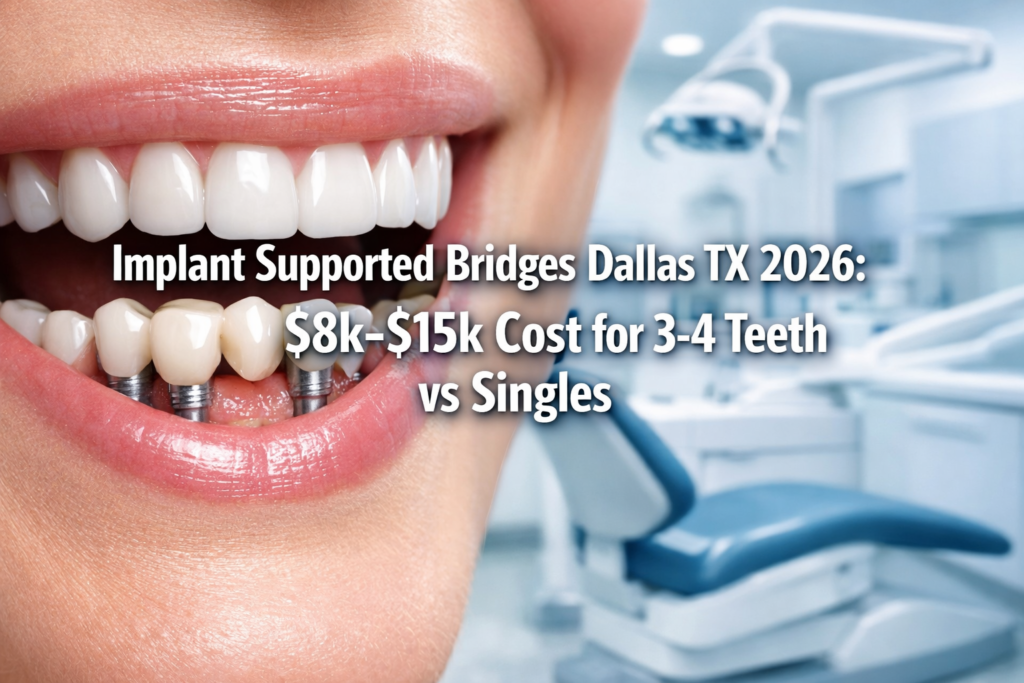
Losing multiple teeth can significantly impact one’s oral health, chewing ability, speech, and overall quality of life. While individual dental implants are often the gold standard for single tooth replacement, a more efficient and equally effective solution exists for replacing several adjacent missing teeth: the implant-supported bridge. In Dallas, TX, in 2026, patients considering this advanced tooth replacement option can anticipate costs for an implant-supported bridge replacing 3-4 teeth to range from approximately $8,000 to $15,000. This article will delve into the details of these costs, compare them to single implants, discuss the procedure, and highlight why this option might be ideal for many Dallas residents.
Dental implants in Dallas offer a durable and stable foundation for various tooth replacement options, including crowns, bridges, and even full arch restorations. An implant-supported bridge provides a fixed solution that looks, feels, and functions much like natural teeth, avoiding the drawbacks associated with traditional removable dentures or bridges that rely on adjacent natural teeth for support. Understanding the nuances of this treatment, including its benefits, process, and associated expenses, is crucial for making an informed decision about your long-term oral health.
Key Takeaways
- Cost Efficiency for Multiple Teeth: In Dallas, TX, in 2026, an implant-supported bridge replacing 3-4 missing teeth typically costs between $8,000 and $15,000. This can be a more cost-effective solution than replacing each missing tooth with an individual dental implant.
- Superior Stability and Comfort: Unlike traditional bridges, implant-supported bridges are anchored directly into the jawbone, offering exceptional stability, preventing bone loss, and providing a comfortable, natural-feeling restoration.
- Preserves Healthy Adjacent Teeth: This option eliminates the need to prepare or grind down healthy adjacent teeth, which is often required for conventional dental bridges.
- Comprehensive Treatment Process: The procedure involves surgical placement of dental implants, a healing period, and the eventual placement of the custom-fabricated bridge, requiring careful planning and multiple appointments.
- Long-Term Investment: While the initial cost may seem substantial, implant-supported bridges offer a long-lasting solution, often exceeding 15-20 years with proper care, representing a significant investment in oral health.
Understanding Implant Supported Bridges Dallas TX 2026: $8k-$15k Cost for 3-4 Teeth vs Singles
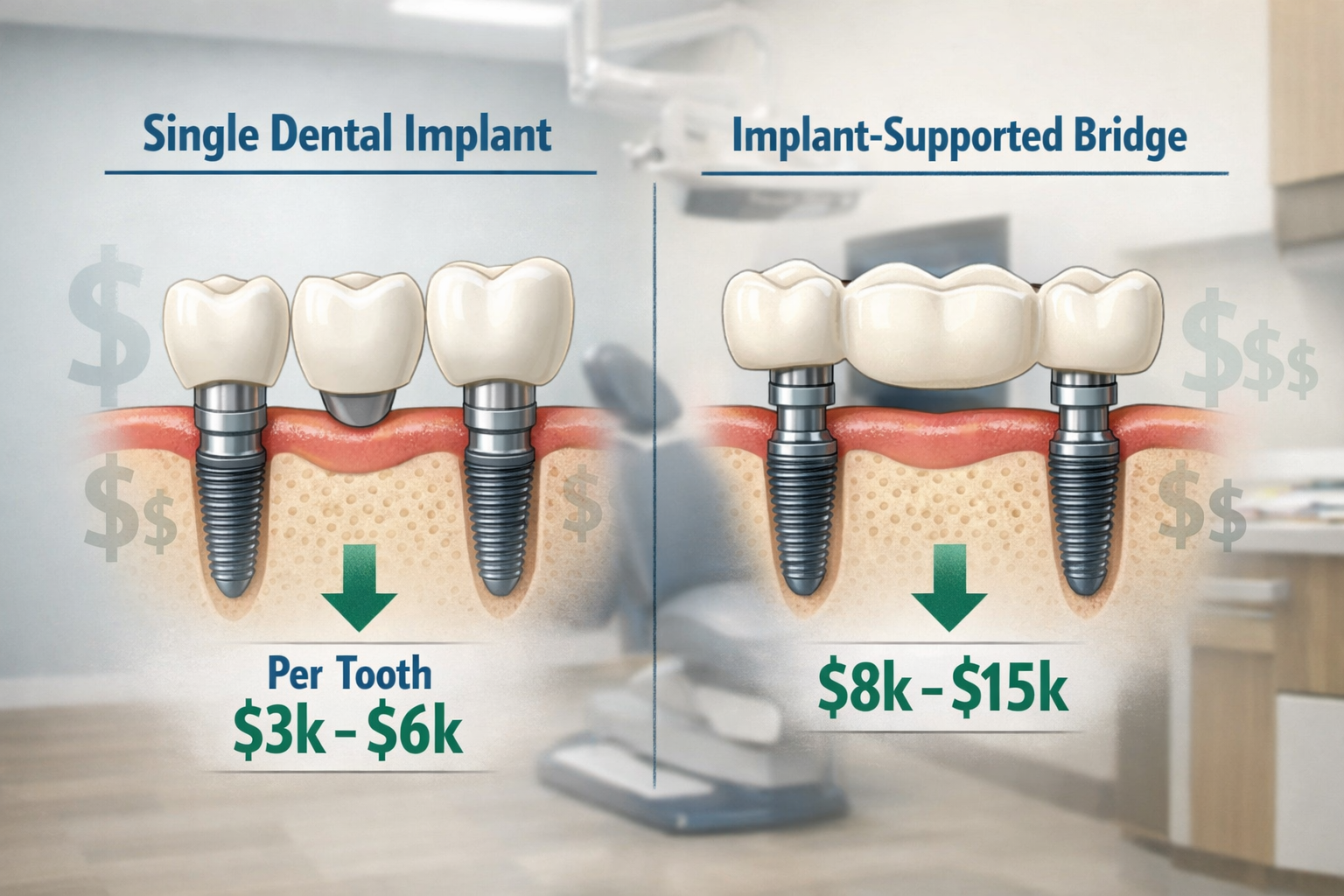
An implant-supported bridge is a restorative dental solution designed to replace three or more consecutive missing teeth. Instead of using a dental implant for each missing tooth, typically two dental implants are strategically placed—one at each end of the gap—to support a bridge of artificial teeth. These implants act as stable anchors, fusing with the jawbone through a process called osseointegration, providing a strong and long-lasting foundation for the bridge. This approach contrasts with replacing each individual missing tooth with its own implant, a method often referred to as single implants.
How an Implant-Supported Bridge Works
The process begins with a comprehensive examination and treatment planning, often involving 3D guided implant surgery for precision. During this phase, a dental professional in Dallas assesses your oral health, bone density, and overall suitability for dental implants. If adequate bone structure is not present, preliminary procedures like a bone graft or sinus lift may be necessary. For more information on such procedures, you can review our guide on Bone Graft Costs for Dental Implants in Dallas.
Once determined suitable, two dental implants are surgically placed into the jawbone. These titanium posts serve as artificial tooth roots. Following placement, a healing period of several months is typically required to allow the implants to fully integrate with the bone. After successful osseointegration, abutments (connectors) are attached to the implants, and then a custom-fabricated dental bridge, made of durable materials like porcelain or zirconia, is securely fastened to these abutments.
Comparing Implant-Supported Bridges for 3-4 Teeth to Single Implants
The choice between an implant-supported bridge and individual single implants depends on several factors, including the number and location of missing teeth, bone density, patient preference, and budget.
Scenario 1: Replacing 3-4 Adjacent Missing Teeth
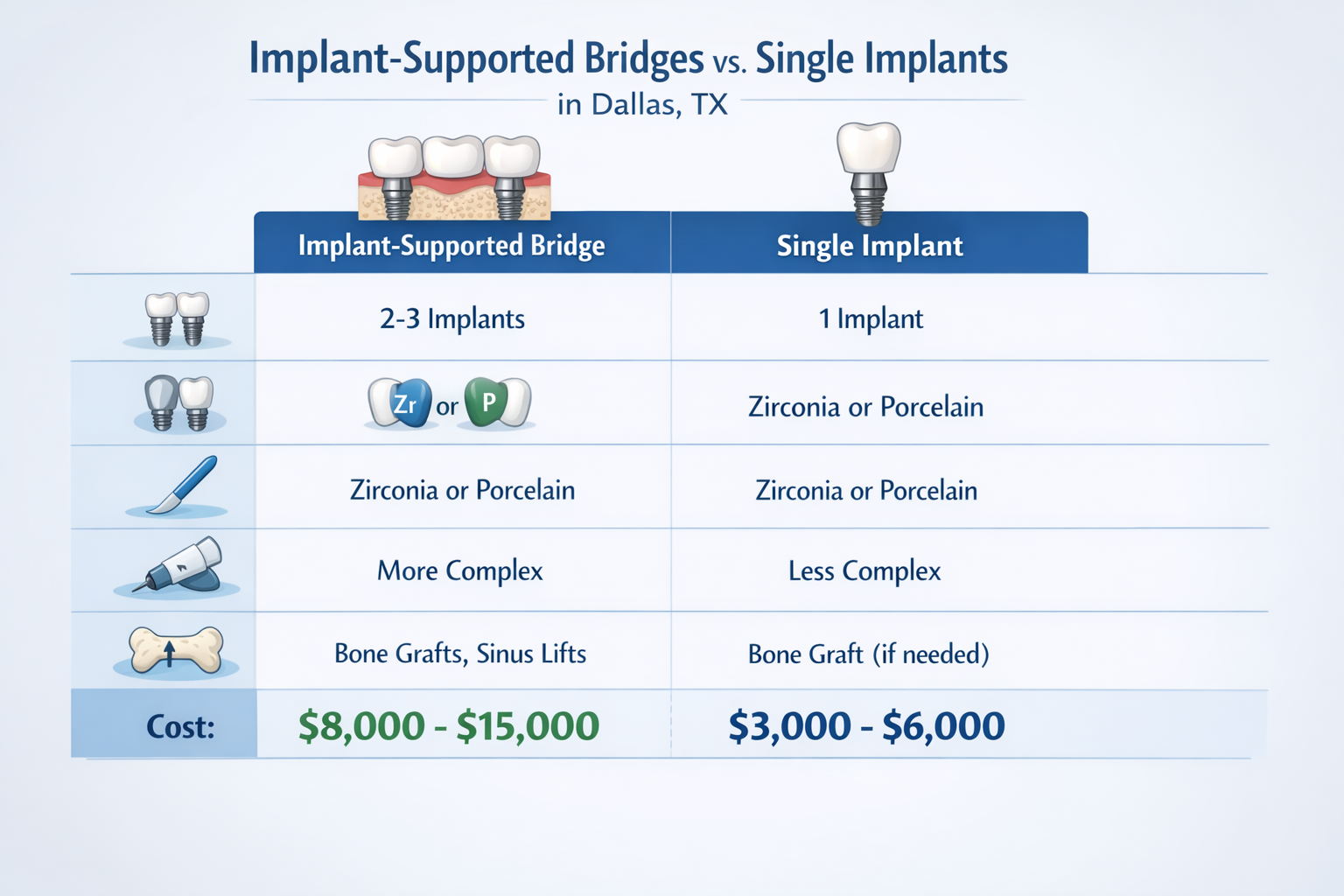
- Implant-Supported Bridge: For 3-4 missing teeth in a row, a common approach is to place two dental implants to support a bridge of 3-4 crowns. This means fewer surgical sites and often a more streamlined procedure than placing three or four individual implants.
- Cost in Dallas (2026): For an implant-supported bridge replacing 3-4 teeth, the estimated cost in Dallas, TX, ranges from $8,000 to $15,000. This encompasses the two implants, abutments, and the multi-unit bridge.
- Individual Single Implants: If each of these 3-4 teeth were replaced with a single implant, you would need 3-4 separate implants, each with its own abutment and crown.
- Cost in Dallas (2026): The average cost for a single dental implant (implant, abutment, and crown) in Dallas can range from $3,000 to $6,000 per tooth. Replacing 3-4 teeth individually could therefore cost $9,000 to $24,000.
As illustrated, for multiple adjacent missing teeth, the implant-supported bridge often presents a more cost-efficient pathway, saving both time and financial resources compared to individual implants for each tooth. For more details on individual implant costs, you can read our article on Factors Affecting Implant Cost in Dallas.
Key Advantages of Implant-Supported Bridges:
- Cost-Effectiveness: Using fewer implants to support multiple teeth can reduce overall treatment costs.
- Preservation of Natural Teeth: Unlike traditional bridges that require grinding down adjacent healthy teeth for support, implant-supported bridges are completely independent, preserving your natural dentition.
- Bone Health: Like single implants, they stimulate the jawbone, preventing bone loss that typically occurs after tooth extraction.
- Durability and Aesthetics: They offer a stable, long-lasting, and natural-looking solution that can significantly improve chewing function and appearance.
- Comfort: Because they are fixed and integrate with the bone, they feel very much like natural teeth, avoiding the discomfort or instability of removable prosthetics.
Choosing the right tooth replacement option requires careful consideration and a thorough consultation with a dentist specializing in dental implants in Dallas. They can assess your specific situation and recommend the most appropriate solution for your long-term oral health.
Factors Influencing the Implant Supported Bridges Dallas TX 2026: $8k-$15k Cost
The $8,000 to $15,000 price range for an implant-supported bridge replacing 3-4 teeth in Dallas, TX, for 2026 is an estimate, and several factors can cause this figure to vary. Understanding these components is essential for patients to anticipate their financial commitment and discuss potential costs transparently with their dental provider.
| Cost Factor | Description | Impact on Cost (Generally) |
|---|---|---|
| Number of Implants | While bridges replace multiple teeth, they typically rely on 2 implants for 3-4 missing teeth. The more implants needed, the higher the cost. | Minimal for a 3-4 tooth bridge (usually 2 implants), but more implants (e.g., for longer spans) would increase total. |
| Type of Bridge Material | Bridges can be made from various materials, primarily porcelain fused to metal (PFM), zirconia, or full contour zirconia. | Zirconia is often more expensive due to its superior strength and aesthetics. |
| Diagnostic & Planning | Includes initial consultation, X-rays, 3D CT scans (e.g., CBCT), digital impressions, and treatment planning. | Essential for precision, often a fixed fee or included in overall estimate. |
| Surgical Fees | Covers the actual placement of the dental implants, anesthesia, and facility fees. Surgical complexity varies by case. | Can vary significantly based on the surgeon’s expertise and the intricacy of the implant placement. |
| Abutments | These are the connectors between the dental implants and the bridge. Custom abutments are often preferred for optimal aesthetics and fit. | Custom abutments generally cost more than standard, pre-fabricated ones. |
| Laboratory Fees | The cost charged by the dental lab to fabricate the custom bridge. This includes materials, craftsmanship, and design. | Varies based on material chosen, complexity of the bridge, and the lab’s quality/reputation. |
| Preliminary Procedures | If sufficient bone is not present, procedures like bone grafting or a sinus lift might be required before implant placement. | Significantly increases overall cost (e.g., Sinus Lift Costs Dallas TX 2026 and Bone Graft Costs for Dental Implants in Dallas can add $1,500-$5,000+). |
| Anesthesia Type | Local anesthesia is standard, but options like oral sedation, nitrous oxide, or IV sedation (administered by an anesthesiologist) incur additional costs. | Varies from a few hundred dollars to over a thousand, depending on type and duration. |
| Geographic Location & Practice | Costs can vary between different dental practices within Dallas, influenced by overhead, technology utilized (e.g., Dallas TX Dentists Using 3D Guided Implant Surgery 2026), and the dentist’s specialization. | Some variation across Dallas, but competitive pricing generally exists. |
| Warranty & Follow-up Care | Some practices include a warranty for implants/restorations and cover post-operative check-ups in the initial fee. | Important to clarify what is included in the total price. |
It’s important to have a detailed discussion with your dental professional in Dallas to receive a personalized cost estimate that outlines all components of your treatment plan. This ensures transparency and helps you understand exactly what you are paying for, allowing you to make an informed decision regarding your dental implant procedure.
The Dental Implant Procedure: A Patient’s Journey in Dallas
Embarking on the journey to restore missing teeth with implant-supported bridges is a multi-stage process that prioritizes patient safety, comfort, and optimal long-term oral health. For residents of Dallas, understanding each step can help alleviate concerns and set realistic expectations.
Step 1: Initial Consultation and Comprehensive Planning
The process always begins with a thorough initial consultation with a qualified dentist in Dallas. During this visit, the dentist will:
- Review your medical and dental history: This includes discussing any pre-existing conditions or medications that might affect the procedure.
- Conduct a comprehensive oral examination: This involves checking the health of your remaining teeth, gums, and overall oral cavity.
- Take diagnostic images: X-rays, including a 3D Cone Beam Computed Tomography (CBCT) scan, are crucial. These images provide detailed information about your jawbone density, nerve locations, and sinus cavities, which is vital for precise implant placement.
- Discuss your goals and expectations: This ensures the treatment plan aligns with your desired outcomes for aesthetics and function.
- Develop a personalized treatment plan: Based on the assessment, the dentist will outline the recommended procedure, including the number of implants, type of bridge, timeline, and a detailed cost breakdown. This is when the nuances of the Implant Supported Bridges Dallas TX 2026: $8k-$15k Cost for 3-4 Teeth vs Singles are thoroughly explained for your specific case.
Step 2: Preliminary Procedures (If Needed)
Some patients may require preparatory procedures before implant placement to ensure the long-term success of the implants.
- Bone Grafting: If the jawbone lacks sufficient density or volume to support implants, a bone graft may be performed. This procedure adds bone material to the site, promoting the growth of new bone. You can learn more about this in our article on Bone Graft Costs for Dental Implants in Dallas.
- Sinus Lift: For implants in the upper back jaw, where the sinus cavity might be too close to the jawbone, a sinus lift procedure may be necessary. This gently raises the sinus floor to create space for bone grafting. More information is available on Sinus Lift Costs Dallas TX 2026.
- These procedures require their own healing periods, which can extend the overall treatment timeline.
Step 3: Dental Implant Placement Surgery
This is the surgical phase where the dental implants are precisely placed into the jawbone.
- Anesthesia: Local anesthesia is typically used to numb the area, ensuring comfort during the procedure. Sedation options are also available for anxious patients.
- Implant Insertion: A small incision is made in the gum tissue, and a pilot hole is carefully drilled into the jawbone at the planned locations. The titanium dental implants are then gently inserted into these sites.
- Temporary Restoration (Optional): In some cases, a temporary bridge or prosthetic may be placed over the surgical site for aesthetic purposes while the implants heal.
Step 4: Osseointegration and Healing
Following implant placement, a crucial healing period begins, known as osseointegration.
- Bone Fusion: Over several months (typically 3-6 months), the dental implants gradually fuse with the surrounding jawbone, creating a strong and stable foundation.
- Monitoring: Regular check-ups are scheduled during this period to monitor the healing progress and ensure successful osseointegration. For seniors, specific healing timelines might apply, as detailed in our Senior Dental Implant Healing Time: Your 2026 Guide.
Step 5: Abutment Placement and Bridge Fabrication
Once osseointegration is complete, the next steps involve preparing for the final bridge.
- Abutment Attachment: A small connector piece called an abutment is attached to each dental implant. This piece will eventually support the dental bridge. Sometimes, the abutment is placed during the initial implant surgery.
- Impressions: New impressions or digital scans of your mouth are taken to create a precise model for the custom fabrication of your dental bridge.
- Bridge Design: The dental laboratory crafts your bridge, ensuring it matches the color, shape, and size of your natural teeth for a seamless and aesthetic result.
Step 6: Final Bridge Placement
The final stage involves securing the custom-made implant-supported bridge.
- Attachment: The bridge is carefully fitted onto the abutments and then permanently cemented or screwed into place.
- Adjustments: The dentist will check your bite and make any necessary adjustments to ensure comfort and proper function.
- Aftercare Instructions: You will receive detailed instructions on how to care for your new implant-supported bridge, including oral hygiene practices and recommended follow-up appointments to ensure its long-term success and address any concerns about long-term oral health.
The entire process, from initial consultation to final bridge placement, can take several months, especially if preliminary procedures are required. However, the result is a durable, functional, and aesthetically pleasing tooth replacement that can last for many years, providing a significant improvement in your quality of life.
Longevity and Maintenance of Implant Supported Bridges
Implant-supported bridges are renowned for their exceptional longevity. With proper care, they can last 15-20 years or even a lifetime. Key factors contributing to their durability include:
- Excellent Oral Hygiene: Regular brushing (twice daily), flossing around and under the bridge, and using an oral irrigator are crucial for preventing plaque buildup and gum disease around the implants.
- Regular Dental Check-ups: Visiting your Dallas dentist for professional cleanings and examinations every six months allows for early detection and management of any potential issues.
- Avoiding Damaging Habits: Refraining from chewing on hard objects, grinding teeth (consider a night guard if you do, as discussed in Protect Your Implants: Stop Teeth Grinding Damage 2026), and smoking can extend the life of your implants and bridge.
By committing to these maintenance practices, patients in Dallas can enjoy the full benefits of their implant-supported bridges for decades, making them a worthwhile investment in long-term oral health.
Financing Your Implant Supported Bridge in Dallas TX 2026
Considering the investment involved, understanding the available financing and payment options for an implant-supported bridge in Dallas, TX, is a crucial part of the decision-making process. While the $8,000-$15,000 cost for a 3-4 tooth bridge may seem substantial upfront, several avenues can help make this advanced tooth replacement option more accessible.
Insurance Coverage
Dental insurance typically offers limited coverage for dental implants, often categorizing them as a major restorative procedure.
- PPO vs. HMO: Preferred Provider Organization (PPO) plans generally offer more flexibility in choosing your dentist and may provide partial coverage for components of the implant procedure, such as extractions, bone grafts, or the crown/bridge itself. Health Maintenance Organization (HMO) plans often restrict you to a network of providers and may have more limited implant benefits.
- Benefit Breakdown: It’s essential to contact your insurance provider directly or have your Dallas dental office assist in submitting a pre-determination of benefits. This will clarify exactly what your plan covers, including any deductibles, annual maximums, and percentages covered for specific procedures related to dental implants in Dallas.
- Medical Coverage for Related Procedures: In some rare instances, if a tooth loss is due to an accident or a medical condition, some medical insurance plans might cover a portion of the surgical costs. This is uncommon but worth investigating if applicable.
For comprehensive information on dental insurance, refer to our guide on Best Dental Insurance for Implants in Texas 2026: PPO vs HMO.
Payment Plans and Financing Options
Many dental practices in Dallas understand the financial commitment of dental implants and offer various payment solutions:
- In-House Payment Plans: Some dental offices provide their own interest-free payment plans, allowing you to pay for your treatment in installments over a period of months.
- Third-Party Medical Financing: Services like CareCredit, LendingClub, or Alphaeon Credit are popular options. These companies offer special financing with low-interest or even 0% APR promotional periods for qualified applicants. This allows patients to spread the cost over an extended period. For more details, see our article on Dental Implant Financing Dallas TX: 0% Plans, CareCredit, and No Credit Check Options.
- Health Savings Accounts (HSAs) and Flexible Spending Accounts (FSAs): If you have an HSA or FSA through your employer, you can use these tax-advantaged accounts to pay for dental implant procedures. Contributions are pre-tax, reducing your taxable income, and withdrawals for qualified medical expenses are tax-free.
- Personal Loans: Banks and credit unions offer personal loans that can be used for medical and dental expenses. Interest rates will vary based on your creditworthiness.
Maximizing Value for Your Investment
When considering the Implant Supported Bridges Dallas TX 2026: $8k-$15k Cost for 3-4 Teeth vs Singles, it’s helpful to view it as a long-term investment in your health and quality of life.
- Longevity: Dental implants have an exceptionally high success rate and can last decades, often a lifetime, with proper care. This makes them a more durable and cost-effective solution in the long run compared to traditional bridges or dentures that may need replacement every 5-10 years.
- Bone Preservation: Implants prevent jawbone loss, which can occur with missing teeth and lead to a sunken facial appearance and further dental problems. This long-term benefit protects your overall oral health.
- Quality of Life: The ability to chew, speak, and smile with confidence can significantly enhance your daily life, making the investment worthwhile.
A detailed consultation with a local Dallas dentist will provide a precise breakdown of costs tailored to your individual needs and help you explore all available financial avenues. Encouraging informed decision-making means fully understanding both the clinical aspects and the financial considerations involved in choosing dental implants in Dallas.
Conclusion

The decision to pursue an implant-supported bridge for 3-4 missing teeth in Dallas, TX, in 2026, is a significant step towards restoring not just your smile, but also your overall oral health and quality of life. With an estimated cost ranging from $8,000 to $15,000, this option often presents a more efficient and cost-effective solution than replacing each missing tooth individually with single dental implants. It provides superior stability, prevents bone loss, and offers a long-lasting, natural-looking restoration that integrates seamlessly with your existing dentition.
Understanding the various factors that influence the cost, from the type of materials used to any necessary preliminary procedures like bone grafts or sinus lifts, is vital for transparent financial planning. Furthermore, exploring financing options such as dental insurance, third-party medical financing, or in-house payment plans can make this advanced treatment more accessible.
Ultimately, an implant-supported bridge is a valuable long-term investment. By providing a durable foundation that mimics natural tooth roots, it allows you to eat, speak, and smile with renewed confidence. We strongly encourage anyone considering this excellent tooth replacement option to schedule a comprehensive consultation with a qualified dentist in Dallas, TX. A personalized assessment will help determine if an implant-supported bridge is the right solution for your unique needs, ensuring patient safety and optimal long-term oral health. This initial consultation with a dentist is the best way to get a precise estimate for your implant cost in Dallas and understand all aspects of the dental implant procedure.