
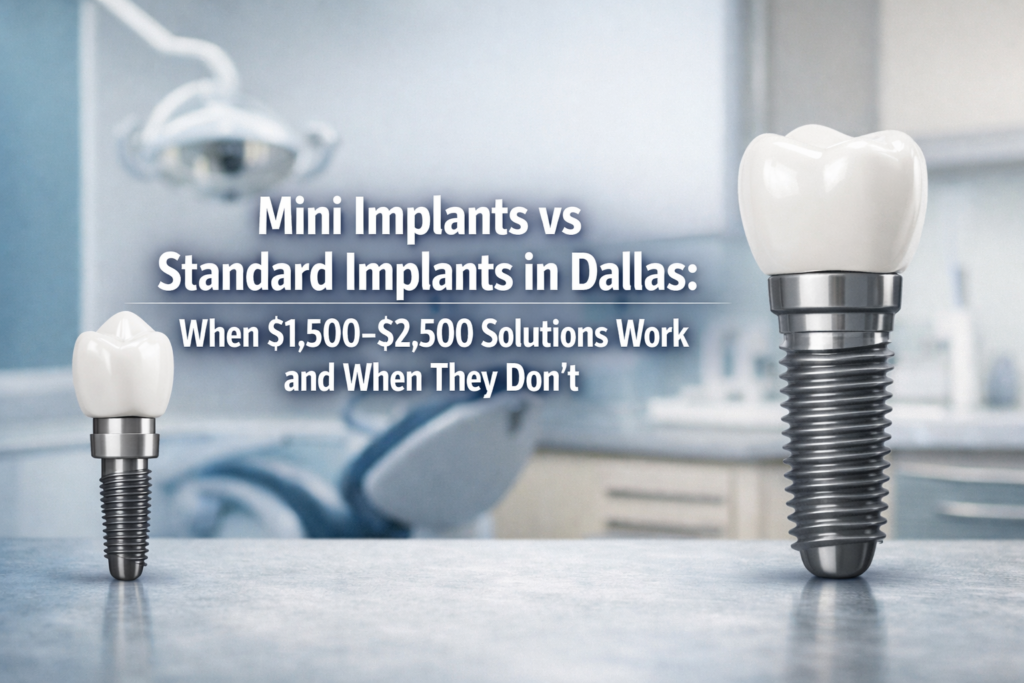
Navigating tooth replacement options can be a complex journey, especially with the variety of choices available today. In Dallas, patients often encounter discussions around mini dental implants as a more affordable alternative to traditional, standard dental implants. While mini implants are gaining traction, offering solutions sometimes in the $1,500-$2,500 range per implant, it’s crucial to understand their specific applications, limitations, and when these seemingly budget-friendly solutions truly work—and when they don’t. This comprehensive guide aims to clarify the distinctions between Mini Implants vs Standard Implants in Dallas: When $1,500-$2,500 Solutions Work and When They Don’t, empowering you to make an informed decision for your long-term oral health.
Key Takeaways
- Mini dental implants are significantly smaller than standard implants and often come with a lower initial cost, typically in the $1,500-$2,500 range per implant in Dallas.
- Mini implants are generally best suited for stabilizing dentures or replacing very small teeth in areas with limited bone, offering a less invasive procedure.
- Standard dental implants are larger, more robust, and designed for long-term stability and strength, ideal for replacing single teeth, multiple teeth, or supporting full-arch restorations.
- While mini implants offer a quicker, more affordable option, they may not provide the same long-term durability or chewing efficiency as standard implants, especially under heavy biting forces.
- A thorough consultation with a qualified dental implant specialist in Dallas is essential to determine which type of implant is appropriate for your specific oral health needs and long-term goals.
Understanding the Fundamentals: Mini vs. Standard Implants
The foundation of informed decision-making for missing teeth solutions lies in understanding the core differences between mini and standard dental implants. Both types of implants serve as artificial tooth roots, providing a stable base for replacement teeth, but they differ significantly in size, placement, and application.
What are Standard Dental Implants?
Standard dental implants are the traditional, well-established choice for tooth replacement. They are typically made from biocompatible titanium, shaped like a screw, and designed to integrate with your jawbone through a process called osseointegration.
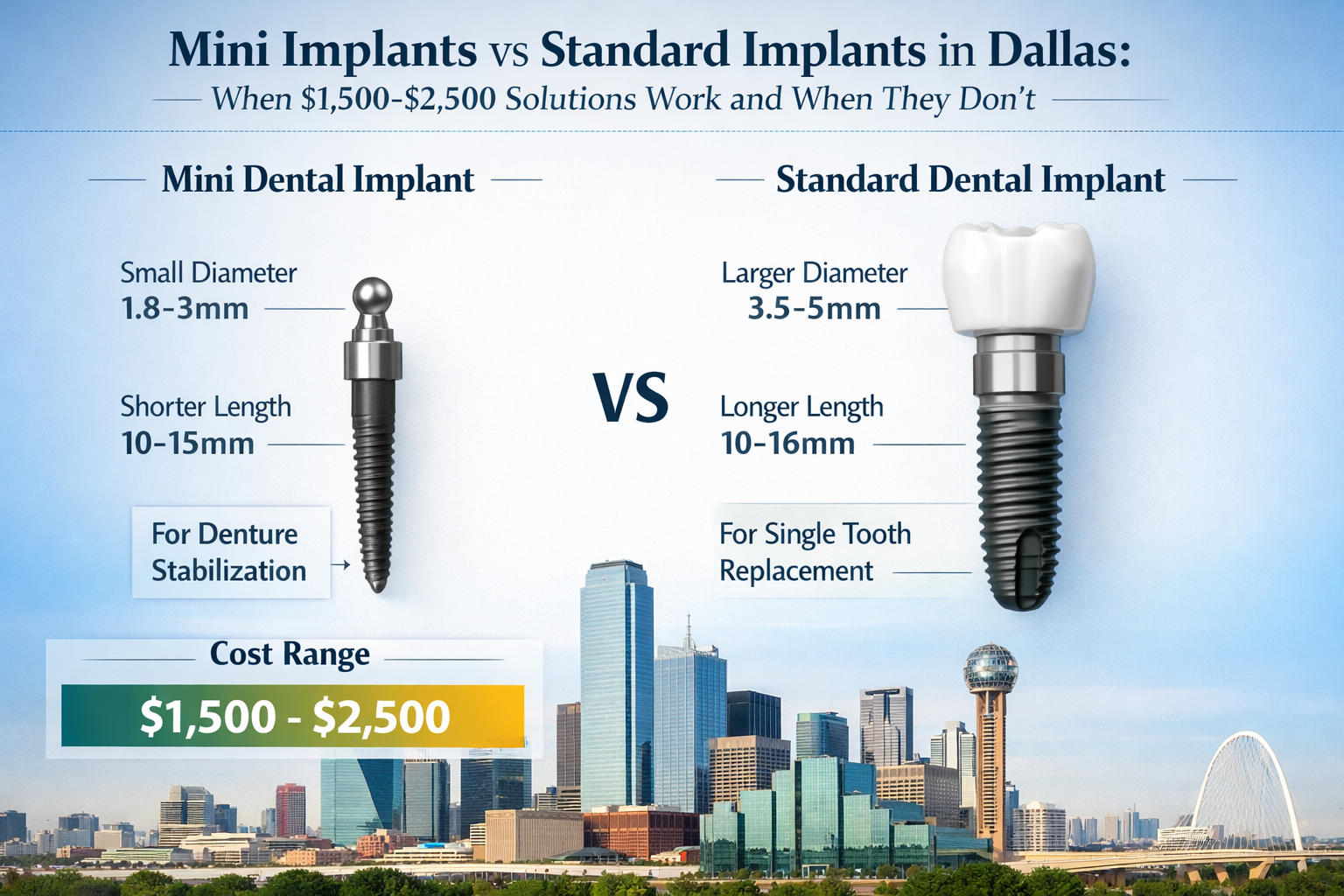
- Size: Standard implants are generally 3.5mm to 6mm in diameter and 8mm to 16mm in length. Their larger size provides a greater surface area for bone contact, leading to superior stability and load-bearing capacity.
- Procedure: The placement of a standard implant often involves a two-stage process: surgical placement of the implant, followed by a healing period (typically 3-6 months) during which osseointegration occurs. Once healed, an abutment and crown are attached.
- Applications: Standard implants are highly versatile. They are ideal for:
- Replacing a single missing tooth. For detailed information on the costs, refer to “Single Tooth Implant Cost Dallas 2026: What $1,500-$5,500 Re”
- Supporting a dental bridge for multiple missing teeth.
- Providing a stable foundation for full-arch restorations, such as All-on-4 or All-on-6 procedures. Explore options like “All-on-4 Dental Implants in Dallas: Cost Breakdown, Timeline”
- Cost in Dallas: While the total cost varies based on complexity and location, a single standard dental implant, including the abutment and crown, can range from $3,000 to $6,000 or more in the Dallas area. This higher price reflects their robust design, longevity, and often more extensive surgical procedure. To learn more about factors influencing these costs, read “Why Dental Implants Cost So Much in Dallas | 2025 Price Guide”.
What are Mini Dental Implants?
Mini dental implants (MDIs) are a newer development, designed to be a less invasive and often more affordable option. They are also made of titanium but are considerably smaller.
- Size: Mini implants are typically less than 3mm in diameter, with some as narrow as 1.8mm. They are also shorter than most standard implants.
- Procedure: Due to their smaller size, mini implants often involve a less invasive surgical procedure. They can sometimes be placed in a single visit, with the restoration attached immediately, reducing overall treatment time.
- Applications: Mini implants are primarily used for:
- Denture stabilization: This is their most common and highly effective use. They provide anchors for removable dentures, preventing slippage and improving chewing efficiency and comfort.
- Temporary restorations: They can serve as temporary anchors during a longer standard implant treatment.
- Replacement of very small teeth: In specific cases, they might replace small incisors or premolars, especially in narrow jaw ridges where standard implants aren’t feasible without extensive bone grafting.
- Cost in Dallas: As highlighted in our discussion about Mini Implants vs Standard Implants in Dallas: When $1,500-$2,500 Solutions Work and When They Don’t, mini implants can range from $1,500 to $2,500 per implant, making them an attractive option for certain patients. This lower cost is primarily due to the simpler procedure and the smaller implant itself. For more insights into mini implant costs, see “Unpacking the Cost: Your 2025 Guide to Mini Dental Implants at Aspen Dental”.
💡 Did You Know? While often seen as a budget-friendly choice, the success and longevity of mini implants heavily depend on proper patient selection and their specific oral health needs. They are not a universal substitute for standard implants.
When $1,500-$2,500 Mini Implant Solutions Work: Ideal Candidates and Scenarios
The appeal of mini dental implants often comes down to their cost-effectiveness and less invasive nature. In Dallas, many patients inquire about these “budget-friendly” options, hoping to find a lasting solution. So, when do these $1,500-$2,500 solutions genuinely work for your oral health?
Best Use Cases for Mini Implants
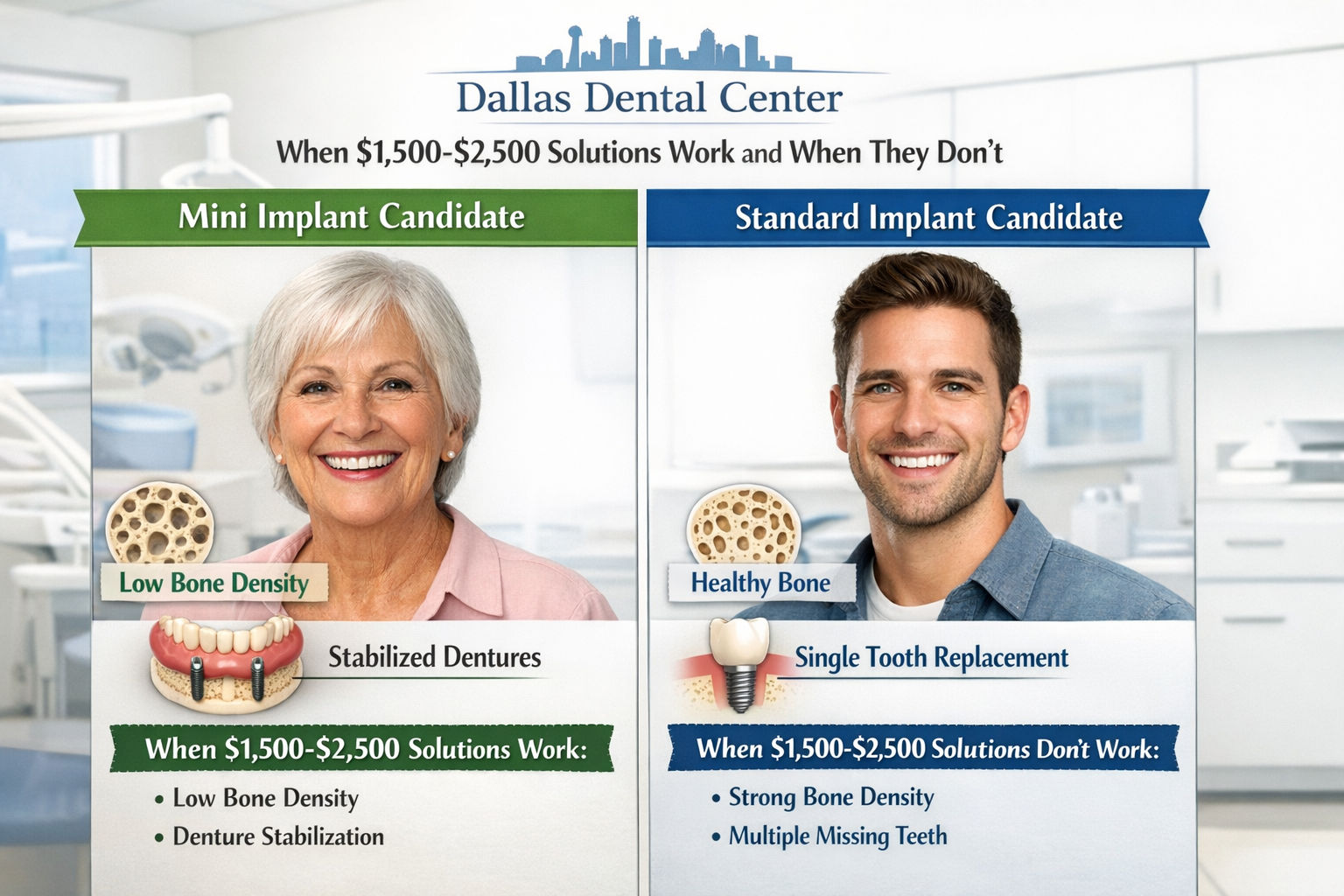
Denture Stabilization for Edentulous Patients: This is arguably the strongest and most common application for mini implants. For individuals who have lost all their teeth and wear traditional full dentures, mini implants can be life-changing.
- Improved Quality of Life: Dentures secured by mini implants eliminate embarrassing slippage, improve chewing ability, and enhance speech and confidence.
- Reduced Bone Resorption: By stimulating the jawbone, albeit to a lesser extent than standard implants, mini implants can help slow down the natural process of bone loss that occurs when teeth are missing.
- Affordability: Compared to full-arch standard implant solutions, securing a denture with 4-6 mini implants is often significantly more affordable, making it a viable option for many. Learn more about Mini Implant Denture Maintenance Guide for 2026.
Patients with Limited Jawbone: Mini implants can be a solution for individuals with significant bone loss who may not be candidates for standard implants without extensive and costly bone grafting procedures. Their narrow diameter requires less bone volume.
Temporary Tooth Replacement: In some cases, mini implants can be used temporarily to support a crown or bridge while a standard implant heals, or until a permanent restoration can be placed.
Replacement of Small Teeth in Low-Stress Areas: For specific small teeth, particularly lower incisors, or in areas of the mouth that experience minimal chewing forces, a mini implant might be a suitable option. However, this is less common and highly dependent on individual circumstances.
Advantages of Mini Implants
- Lower Initial Cost: The primary advantage of mini implants in Dallas, ranging from $1,500-$2,500, makes them financially accessible to a wider range of patients. This cost saving is due to a less complex procedure and smaller components.
- Minimally Invasive Procedure: The smaller size of mini implants means less drilling and often less trauma to the jawbone, leading to a quicker procedure and faster healing.
- Faster Healing and Restoration: In many cases, mini implants can be loaded immediately, meaning dentures or temporary crowns can be attached on the same day as placement.
- Reduced Need for Bone Grafts: For patients with moderate bone loss, mini implants might bypass the need for a bone graft, saving time, cost, and additional surgery.
When $1,500-$2,500 Mini Implant Solutions Don’t Work: Limitations and Risks
While mini implants offer compelling advantages, it’s equally important for patients in Dallas to understand their limitations. There are critical scenarios where opting for a $1,500-$2,500 mini implant solution may not be the optimal, long-term choice and could lead to complications or dissatisfaction. This is a crucial aspect of understanding Mini Implants vs Standard Implants in Dallas: When $1,500-$2,500 Solutions Work and When They Don’t.
Scenarios Where Standard Implants Are Superior
Replacing Single Posterior Teeth or Multiple Missing Teeth: For molar or premolar replacement, or when replacing several teeth, standard implants are almost always the preferred choice.
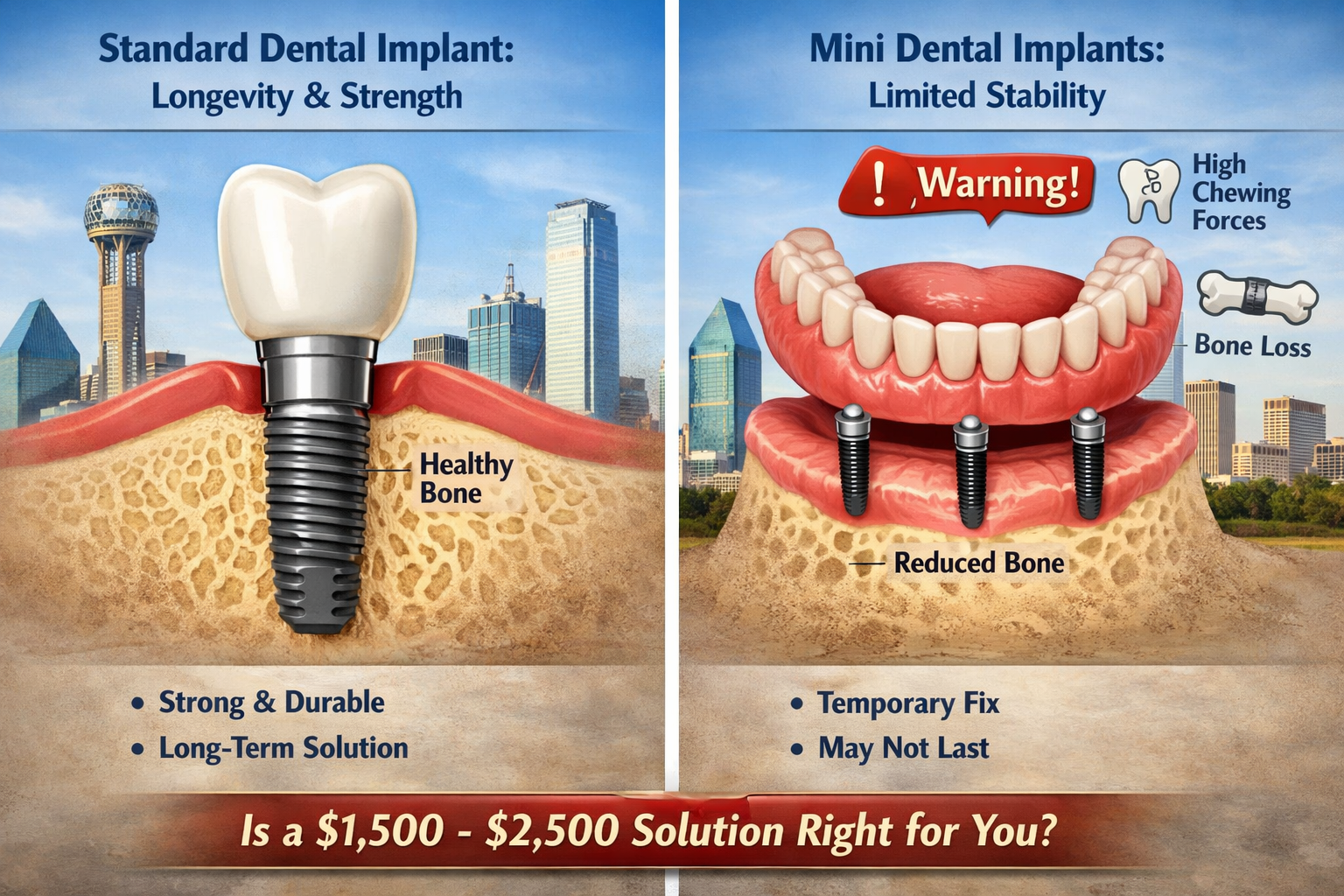
- Chewing Forces: Posterior teeth bear the brunt of chewing forces. Mini implants, with their smaller diameter, may not withstand these forces long-term and are at a higher risk of fracture or failure.
- Stability and Longevity: Standard implants offer superior stability, predictable osseointegration, and a proven track record of decades of success, especially in high-stress areas.
Full-Arch Fixed Restorations (e.g., All-on-4): For patients seeking a permanent, non-removable full-arch solution, standard implants (often 4-6 implants per arch) are necessary. Mini implants lack the foundational strength to support a fixed, full-arch bridge. Compare options like “All-on-6 vs All-on-4 Implants Dallas TX: 2026 Cost Compariso” to understand the scope.
Patients with Good Bone Density: If you have sufficient jawbone, there’s little advantage to choosing a mini implant over a standard one for single-tooth replacement. The standard implant will provide a more durable and stable foundation.
Long-Term Predictability and Strength: While mini implants are excellent for stabilizing dentures, they are generally not designed for the same level of long-term, independent tooth replacement as standard implants. Their smaller size means less surface area for bone integration, potentially leading to lower overall strength and greater susceptibility to complications under excessive load.
Potential Limitations and Risks of Mini Implants
- Reduced Load-Bearing Capacity: The most significant drawback is their inability to withstand heavy chewing forces. This can lead to fracture of the implant, loosening, or premature failure, especially if used inappropriately.
- Durability Concerns: While effective for denture stabilization, mini implants may not offer the same decades-long predictability as well-placed standard implants for individual tooth replacement. They might require earlier replacement or maintenance.
- Limited Customization: Standard implants offer a wider range of abutment and crown options, allowing for highly customized, natural-looking restorations. Mini implants have fewer prosthetic options.
- Risk of Revision Surgery: If a mini implant fails due to inadequate support or excessive force, it could necessitate a more complex revision dental implant surgery in Dallas down the line, potentially increasing overall costs and patient discomfort.
⚠️ Important Consideration: Choosing a $1,500-$2,500 mini implant solution when a standard implant is truly needed can lead to premature failure, requiring additional costly procedures in the future. Prioritizing initial cost over long-term suitability can be a false economy.
Making Your Informed Decision in Dallas: Consultation is Key
When considering Mini Implants vs Standard Implants in Dallas: When $1,500-$2,500 Solutions Work and When They Don’t, the most important step is a thorough consultation with an experienced dental implant specialist. A qualified dentist or oral surgeon in Dallas will conduct a comprehensive examination of your oral health, including detailed imaging (X-rays, CBCT scans) to assess your jawbone density and overall suitability for different implant types.
Factors Your Dentist Will Consider:
- Bone Density and Quantity: This is perhaps the most critical factor. Sufficient bone is essential for implant stability.
- Location of Missing Teeth: Anterior (front) teeth typically experience lighter chewing forces than posterior (back) teeth.
- Overall Oral Health: Any existing gum disease or other oral health issues must be addressed prior to implant surgery.
- Medical History: Certain systemic conditions or medications can impact implant success.
- Patient Expectations and Goals: Understanding your lifestyle, chewing habits, and desired outcome is vital.
- Budget: While cost is a factor, it should not be the sole determinant. A cheaper solution that fails prematurely is rarely a true saving. For a broader understanding of costs, consider exploring “Dental Implants Dallas TX: Costs, Procedure & Top Specialists 2025”.
Questions to Ask Your Dallas Dentist:
- “Am I a good candidate for mini implants, or would standard implants be better for my specific case?”
- “What are the pros and cons of each option for my long-term oral health?”
- “What is the expected lifespan of each type of implant in my situation?”
- “What is the total cost breakdown for the recommended procedure, including all components and follow-up care?”
- “What are the potential risks and complications associated with each option?”
- “What kind of maintenance will be required for mini versus standard implants?”
Choosing between mini and standard implants is a significant decision that impacts your oral health for years to come. By prioritizing patient safety, long-term oral health, and a realistic understanding of each tooth replacement option, you can work with your Dallas dental professional to select the solution that best fits your needs, expectations, and budget.
Conclusion
Understanding the differences between mini implants and standard implants is vital for anyone considering tooth replacement options in Dallas. While mini implants offer an attractive $1,500-$2,500 price point and a less invasive procedure, they are not a universal solution. They excel in specific applications, particularly for stabilizing loose dentures and in cases of limited bone availability, providing significant improvements in quality of life.
However, for single-tooth replacements, particularly in areas of high chewing force, or for robust full-arch fixed restorations, standard dental implants remain the gold standard due to their superior strength, stability, and long-term predictability. Attempting to use a mini implant where a standard implant is truly needed can lead to complications, discomfort, and potentially more expensive revision surgeries in the future.
Your journey to a healthier, more confident smile begins with accurate information and a personalized approach. We strongly encourage a comprehensive consultation with a skilled dental implant specialist in Dallas to evaluate your unique oral health profile, discuss all available options, and determine whether a mini implant solution or a standard implant solution is the right choice for your long-term success. Making an informed decision, based on expert advice and a clear understanding of the benefits and limitations, is the best path to achieving lasting oral health and a confident smile.