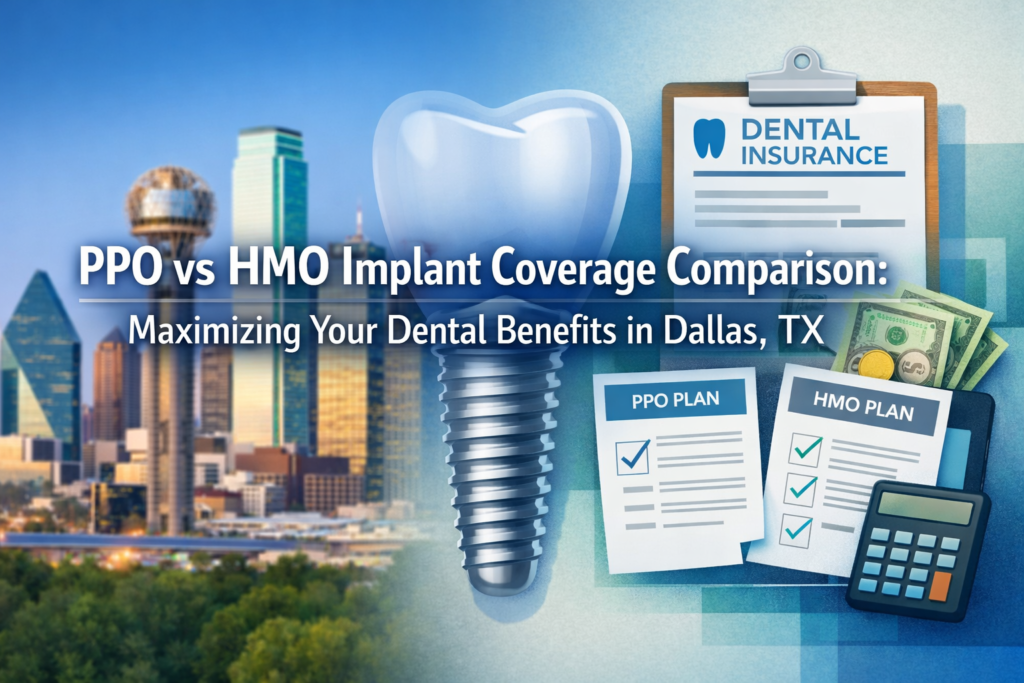
Navigating the landscape of dental insurance can be complex, especially when considering significant procedures like dental implants. For patients in Dallas, TX, understanding the nuances between PPO (Preferred Provider Organization) and HMO (Health Maintenance Organization) plans is crucial for maximizing dental benefits and ensuring access to quality tooth replacement options. This comprehensive guide provides a detailed PPO vs HMO implant coverage comparison, outlining the differences, common benefits, and strategies to optimize your insurance payouts for dental implants in Dallas during 2026.
Dental implants offer a durable and aesthetic solution for missing teeth, providing long-term oral health benefits. However, the cost can be a significant consideration, making insurance coverage a vital component of the treatment plan. This article aims to demystify dental insurance for Dallas residents, helping them make informed decisions about their oral health.
Key Takeaways
- PPO plans offer greater flexibility: You can choose any licensed dentist, including out-of-network providers, although in-network care typically costs less.
- HMO plans require in-network care: You must select a primary dental provider within the plan’s network and often need referrals for specialists.
- Implant coverage varies widely: Neither PPO nor HMO guarantees full coverage for dental implants; coverage depends on your specific plan’s details, including deductibles, annual maximums, and waiting periods.
- Pre-authorization is essential: Always seek pre-authorization for dental implants to understand your estimated out-of-pocket costs and avoid unexpected bills.
- Strategize for maximum benefits: Utilize annual maximums wisely, consider financing options, and understand your plan’s terms to optimize your investment in dental implants in Dallas.
Understanding PPO vs HMO Dental Plans for Implants in Dallas, TX
The choice between a PPO and an HMO dental plan significantly impacts how you access and pay for dental implant procedures. Both plan types have distinct structures that influence your provider choice, out-of-pocket expenses, and the overall process of receiving care.
PPO Dental Plans: Flexibility and Choice
PPO plans offer a higher degree of flexibility. With a PPO, you are not restricted to a specific network of dentists. You can visit any licensed dentist or specialist, including those not within your plan’s network, although you will generally pay less if you choose an in-network provider. This flexibility is often a significant advantage for individuals seeking specific expertise or those who have an established relationship with a particular Dallas dental implant specialist.
PPO Coverage for Dental Implants
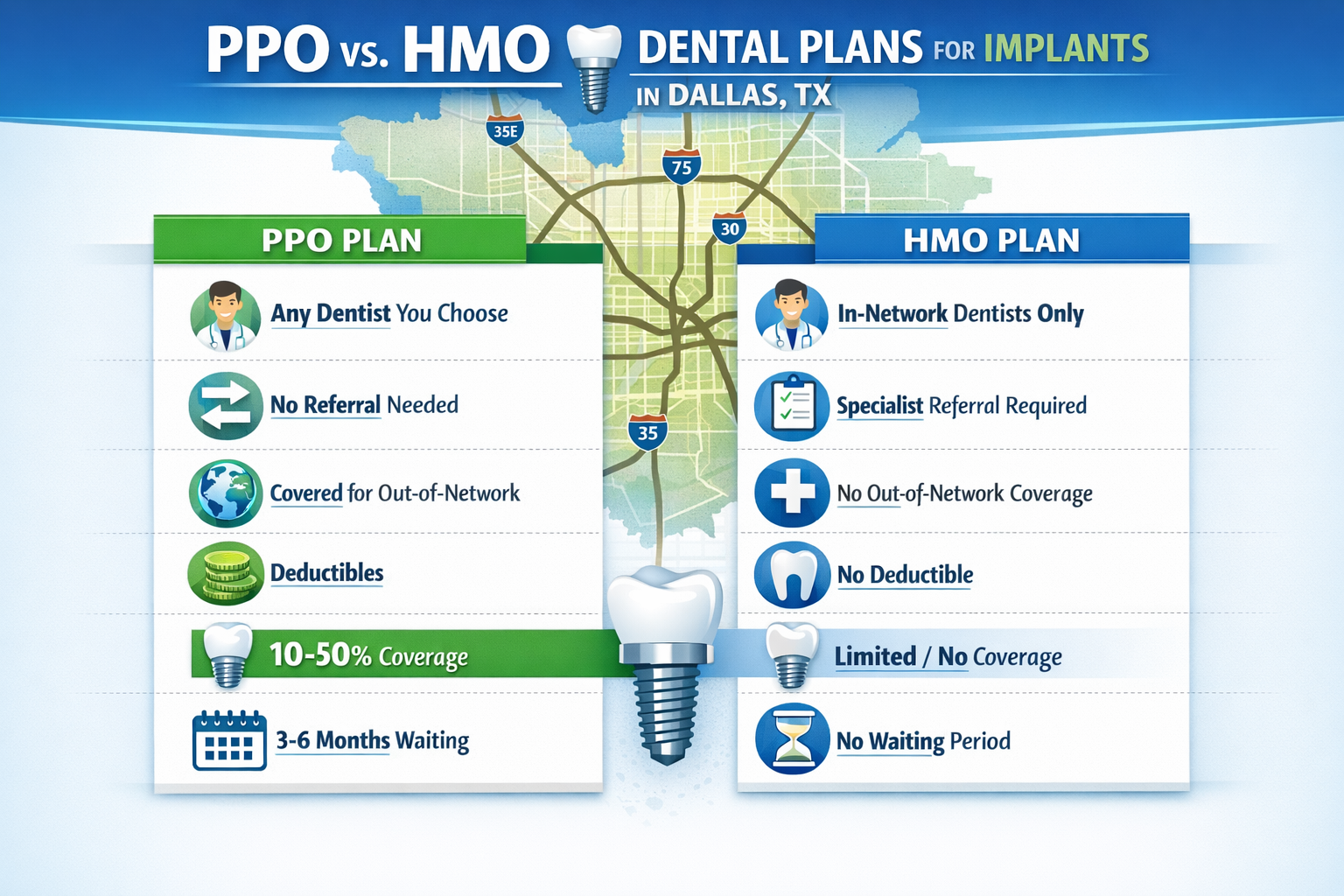
For dental implants, PPO plans typically cover a percentage of the cost after you meet your deductible. This percentage can range widely, often from 10% to 50% for major restorative procedures. Important considerations for PPO plans include:
- Deductibles: The amount you must pay out-of-pocket before your insurance begins to cover costs.
- Annual Maximums: The maximum amount your insurance company will pay for your dental care within a plan year. This is a critical factor for dental implants, as they can be a significant investment. For more details on dental implant insurance, explore our guide on Dental Implant Insurance Dallas: Complete Coverage Guide 2025.
- Waiting Periods: Many PPO plans have waiting periods (e.g., 6-12 months) before they will cover major procedures like dental implants.
- Co-insurance: The percentage of the cost you are responsible for after meeting your deductible.
HMO Dental Plans: Network-Based Care
HMO dental plans operate differently. With an HMO, you are typically required to choose a primary care dentist from a specific network of providers. This dentist will manage your general dental care and must provide referrals if you need to see a specialist, such as an oral surgeon for dental implant placement. HMO plans generally have lower monthly premiums and may have no deductibles or annual maximums, offering fixed co-payments for services.
HMO Coverage for Dental Implants
HMO coverage for dental implants can be more restrictive. Some HMO plans may offer limited or no coverage for dental implants, classifying them as cosmetic or experimental. When coverage is provided, it usually comes with a fixed co-payment, but you must strictly adhere to the plan’s network and referral system. Key aspects of HMO plans include:
- Fixed Co-payments: You pay a set fee for services, regardless of the total cost.
- No Deductibles/Annual Maximums (often): This can be a benefit for routine care but may not apply to complex procedures if they are excluded.
- Network Restriction: You must stay within the network for coverage.
- Referral System: Specialists require a referral from your primary dentist.
PPO vs HMO Implant Coverage Comparison: Key Differences at a Glance
| Feature | PPO (Preferred Provider Organization) | HMO (Health Maintenance Organization) |
|---|---|---|
| Provider Choice | High: Can choose any licensed dentist; lower costs in-network | Limited: Must choose from a specific network of providers |
| Referrals | Not typically required for specialists | Usually required for specialists, including oral surgeons |
| Out-of-Network | Covered, but at a higher out-of-pocket cost | Generally not covered |
| Deductible | Common | Often none or very low |
| Annual Maximum | Common | Often none, but coverage for major procedures may be limited or excluded |
| Premiums | Generally higher | Generally lower |
| Implant Coverage | Typically covers a percentage (e.g., 10-50%) after deductible | Varies widely; often limited, fixed co-payments, or no coverage |
| Cost Control | Share of cost (co-insurance) | Fixed co-payments |
For Dallas patients considering dental implants for missing front teeth, understanding these differences is paramount to planning both treatment and finances.
Maximizing Your Dental Benefits for Implants in Dallas, TX
Regardless of whether you have a PPO or HMO plan, strategic planning can help you get the most out of your dental benefits for procedures like dental implants. The goal is to minimize your out-of-pocket expenses while ensuring you receive the high-quality care you need for long-term oral health.
Step-by-Step Approach to Maximizing Benefits
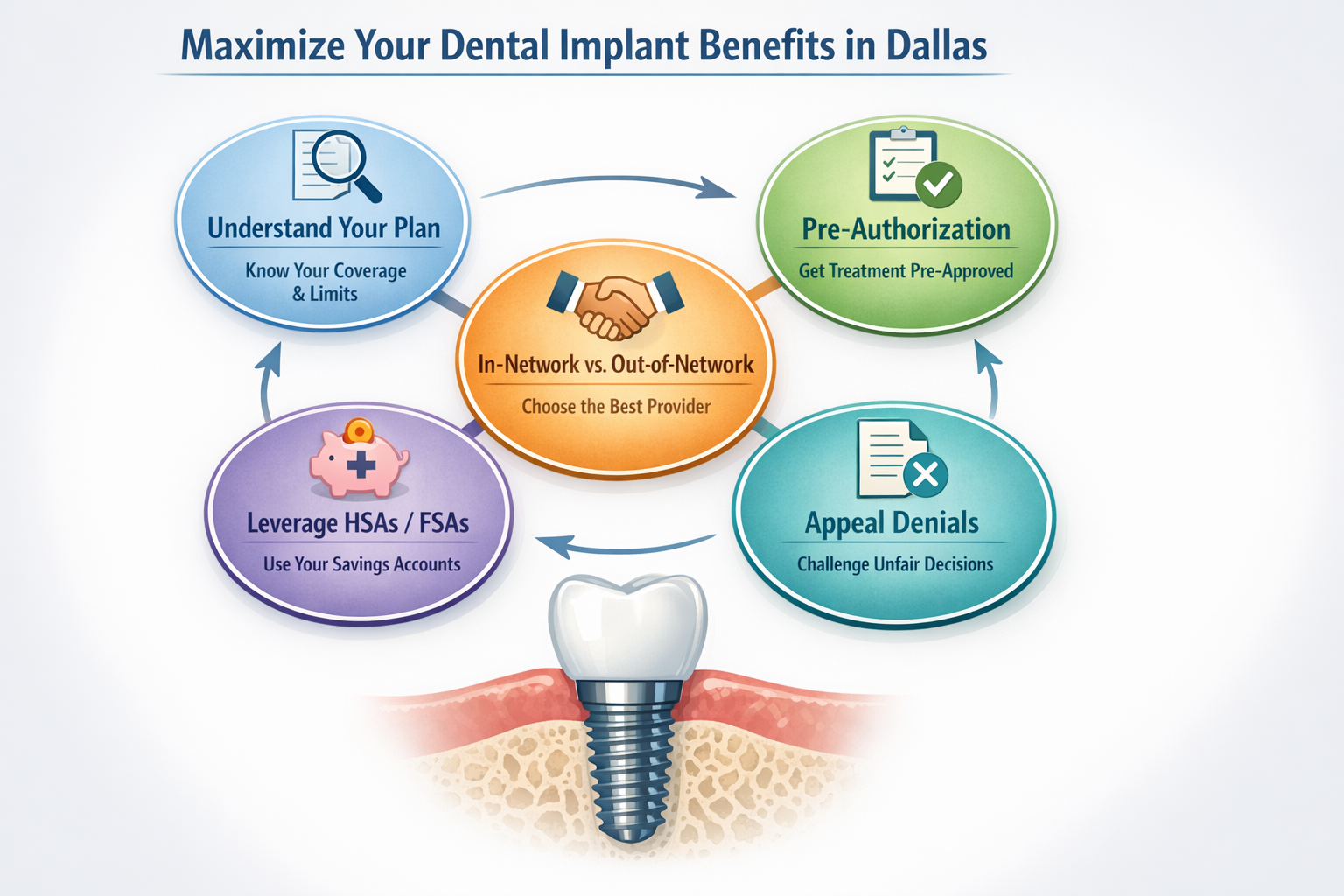
- Review Your Plan Documents Thoroughly: Before scheduling any procedure, obtain a copy of your dental plan’s Summary of Benefits and Coverage (SBC). Look for specific clauses regarding “major restorative” or “oral surgery” coverage, paying close attention to exclusions for dental implants or related procedures like bone grafts.
- Request a Pre-Authorization/Pre-determination: This is perhaps the most critical step for dental implants. Have your dentist submit a pre-authorization request to your insurance company. This outlines the proposed treatment plan, codes, and estimated costs. The insurer will respond with an estimate of what they will cover, how much you will owe, and if the procedure is covered at all. This prevents surprises later.
- Understand Deductibles and Annual Maximums:
- Deductible: If your plan has a deductible, ensure you know how much it is and if you have met it. Some plans might categorize different services under separate deductibles.
- Annual Maximum: For PPO plans, dental implant costs can quickly exceed your annual maximum. If your treatment spans two calendar years, you might be able to strategically schedule parts of the procedure (e.g., implant placement in one year, crown placement in the next) to utilize two annual maximums. This can significantly reduce your out-of-pocket costs.
- In-Network vs. Out-of-Network Providers:
- PPO: Always ask your Dallas dentist if they are in-network with your PPO plan. While you can choose an out-of-network provider, your co-insurance and deductible may be higher, and the amount the insurance company pays may be less.
- HMO: Strictly adhere to your network. If your plan requires referrals for specialists, ensure your primary dentist provides one before seeing an oral surgeon for implant surgery.
- Explore Alternative Coverage for Related Procedures: Some dental plans may not cover the implant itself but might cover associated procedures like extractions, bone grafting, or the crown that goes on top of the implant. Always inquire about these component coverages. For information on bone graft costs for dental implants in Dallas, TX, see our detailed guide.
- Consider an FSA or HSA: If you have a Flexible Spending Account (FSA) or Health Savings Account (HSA), these tax-advantaged accounts can be used to pay for out-of-pocket dental implant costs, deductibles, and co-insurance. This can offer substantial savings. Learn more about Dallas Dental Implants HSA/FSA Eligible Expenses 2026.
- Appeal Denials: If your claim for dental implants is denied, do not hesitate to appeal. Insurance companies sometimes deny claims that should be covered. Provide additional documentation, letters of medical necessity from your dentist, and clearly outline why the procedure is essential for your oral health, not just cosmetic.
“Understanding your dental insurance is the first step toward a successful dental implant journey. For Dallas residents, knowing how your PPO or HMO plan specifically addresses major restorative work like implants can save you significant time and money.”
Specific Considerations for Dental Implants in Dallas, TX
- Local Cost Variations: Dental implant cost in Dallas can vary between clinics. It is advisable to get multiple quotes and understand what each quote includes (e.g., implant, abutment, crown, surgical fees, sedation). For specific insights into pricing, refer to our 2026 Dallas Dental Implant Cost Update: Single Tooth to Full Mouth Pricing.
- Sedation Options: If your dental implant procedure requires sedation, check if your plan covers these costs. Some plans may cover local anesthesia but not IV sedation or general anesthesia. Our article on Sedation Options for Dental Implants Dallas TX provides valuable information.
- Financing Options: Even with insurance, a portion of the cost will likely be out-of-pocket. Many Dallas dental implant providers offer financing plans, payment plans, or accept third-party medical financing to help make treatment more affordable. Explore Dallas Dental Implant Financing Options | Payment Plans 2025.
By diligently following these steps, Dallas patients can navigate their dental insurance plans more effectively, transforming the often-daunting prospect of dental implant costs into a manageable part of their journey towards a healthier smile.
Advanced Strategies for Navigating Implant Coverage and Cost in 2026
Beyond the basic understanding of PPO and HMO structures, there are advanced strategies Dallas patients can employ to further reduce costs and ensure their dental implant procedures are as financially smooth as possible in 2026.
The “Medical Necessity” Argument
Dental insurance companies often classify dental implants as “cosmetic” to limit coverage. However, dental implants are rarely purely cosmetic; they are crucial for restoring chewing function, preventing bone loss, and maintaining the integrity of adjacent teeth. Your dentist can help by:
- Documenting Medical Necessity: Providing detailed notes, X-rays, and photos demonstrating the functional impairments caused by missing teeth.
- Using Appropriate Coding: Ensuring that the submitted procedure codes accurately reflect the restorative and functional aspects of the dental implant treatment rather than purely cosmetic ones.
It is important to emphasize that dental implants are a superior missing teeth solution compared to traditional bridges or dentures in terms of longevity and bone preservation, solidifying their medical necessity.
Leveraging Different Types of Insurance
Sometimes, a portion of your dental implant procedure might be covered by your medical insurance, especially if the tooth loss was due to an accident, trauma, or a medical condition.
- Medical vs. Dental Insurance: The surgical placement of the dental implant post might be billed to medical insurance if it’s considered part of an injury or disease treatment. The restorative part (abutment and crown) usually falls under dental.
- Coordination of Benefits: If you have both dental and medical insurance, understand how coordination of benefits works. One plan might be primary, and the other secondary, covering remaining costs up to a certain limit.
This dual-coverage approach can be complex, requiring careful coordination between your dental office, your medical provider, and both insurance companies. Always consult with your dental implant specialist in Dallas to explore this option.
Understanding Plan Exclusions and Limitations for PPO vs HMO Implant Coverage Comparison
Both PPO and HMO plans often have specific exclusions that can impact dental implant coverage. Being aware of these can help you plan proactively.
- Missing Tooth Clause: Some plans will not cover dental implants for teeth that were missing before you enrolled in the plan. This “missing tooth clause” can be a major hurdle. Always check if your plan has this limitation and when it would no longer apply.
- Cosmetic Exclusion: As mentioned, if implants are deemed purely cosmetic, coverage will be denied.
- Waiting Periods: Reiterate the importance of knowing and planning around waiting periods for major procedures. Enrolling in a plan well in advance of needing an implant can prevent delays.
- Alternative Benefits Clause: Some plans have an “alternative benefits” clause, meaning they will only cover the cost of the least expensive treatment option that meets your needs (e.g., a removable partial denture or bridge instead of an implant), even if your dentist recommends implants. You would then pay the difference.

By understanding these potential limitations, Dallas patients can engage in more effective conversations with their insurance providers and dental teams. This proactive approach ensures that when they embark on their dental implant journey, they are fully prepared for the financial aspects, maximizing their investment in their long-term oral health.
Conclusion
The decision to get dental implants is a significant one, offering transformative benefits for your oral health and quality of life. For Dallas, TX, residents, understanding the PPO vs HMO implant coverage comparison is a critical step in making this advanced tooth replacement option accessible and affordable. While PPO plans typically offer greater flexibility in choosing your dental implant provider, HMO plans often come with lower premiums and a structured network approach.
No matter your plan type, successful navigation of your dental benefits requires diligence: thorough review of plan documents, timely pre-authorizations, strategic scheduling to leverage annual maximums, and exploring all available financing options. By becoming an informed patient and working closely with your chosen dental implant specialist, you can maximize your insurance payouts and make an informed investment in your smile and overall well-being in 2026.
Actionable Next Steps:
- Contact Your Insurance Provider: Call the member services number on your insurance card to discuss your specific dental implant coverage, waiting periods, deductibles, and annual maximums.
- Consult with a Dallas Dental Implant Specialist: Schedule a consultation with a qualified dentist in Dallas to discuss your eligibility for dental implants and obtain a detailed treatment plan and cost estimate.
- Request Pre-Authorization: Ask your dental office to submit a pre-authorization request to your insurance company before starting treatment.
- Explore Financing: Discuss payment plans or financing options directly with your dental office to cover any out-of-pocket expenses.
Remember, investing in dental implants is an investment in your health. With careful planning and a clear understanding of your benefits, Dallas patients can achieve a lasting, healthy smile.