
Approximately 177 million Americans are missing at least one permanent tooth, and dental implants have become a leading solution for restoring oral health and function. For residents in Dallas considering this advanced tooth replacement option, understanding how dental insurance plans for implants in Dallas 2026 work is crucial. This article aims to provide a clear, side-by-side comparison of coverage, waiting periods, and annual maximums across various plan types, helping you navigate the financial aspects of dental implant treatment in Dallas. Our goal is to offer comprehensive, medically responsible information to empower your decision-making process.
Key Takeaways
- Dental implant coverage varies significantly by plan, with PPO options generally offering better benefits than HMOs or discount plans.
- Most plans have waiting periods, often 6-12 months, for major procedures like dental implants, which must be factored into your treatment timeline.
- Annual maximums, typically ranging from $1,000 to $2,500, often fall short of the total cost of dental implants, requiring significant out-of-pocket expenses.
- Pre-treatment estimates are vital to understand exact coverage and patient responsibility before starting any dental implant procedure.
- Combining insurance with other financial strategies, such as financing or dental savings plans, can help manage implant costs in Dallas.
Dental Insurance Plans for Implants in Dallas 2026: Comparing Coverage Types
When exploring dental insurance plans for implants in Dallas 2026, it’s important to differentiate between the primary types of dental insurance and how each typically approaches coverage for major restorative procedures like dental implants. Understanding these distinctions is the first step in estimating your potential out-of-pocket costs for a dental implant procedure.
PPO (Preferred Provider Organization) Plans
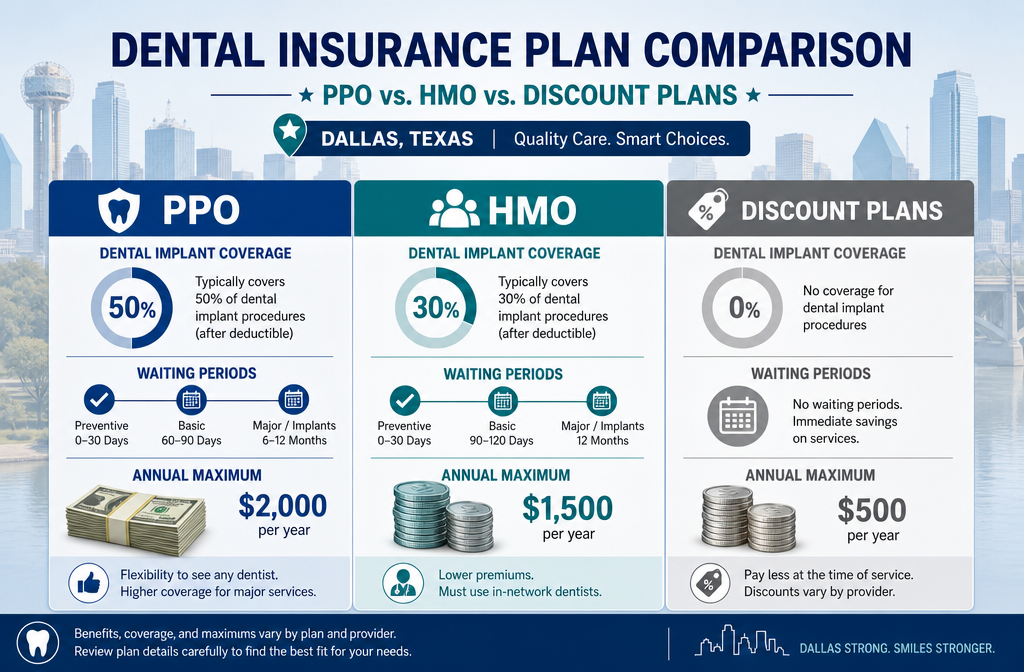
PPO plans offer more flexibility in choosing your dentist. While they have a network of “preferred” providers, you can generally see any licensed dentist, though you’ll pay less if you stay within the network. For dental implants in Dallas, PPO plans often provide the most favorable coverage among traditional insurance options.
- Coverage Percentage: PPO plans typically cover a percentage of major restorative procedures after a deductible. For dental implants, this can range from 30% to 70% of the allowed amount, with 50% being a common figure. This percentage usually applies to the implant crown, abutment, and the surgical placement of the implant post itself. Some plans may cover different components at different rates.
- Realistic Out-of-Pocket Range (Single Tooth Implant): For a single tooth implant in Dallas, which can cost anywhere from $3,000 to $6,000 without insurance, a PPO plan covering 50% might reduce your direct cost by $1,500 to $3,000, assuming you haven’t hit your annual maximum. Your actual out-of-pocket will still be substantial, often in the range of $2,000 to $4,500 per implant.
- Realistic Out-of-Pocket Range (Full Arch Implants): For full arch solutions like All-on-4 dental implants in Dallas, which can range from $15,000 to $30,000 per arch, PPO coverage will offer a smaller percentage of the total. Given the high cost, you will quickly reach your annual maximum. Your out-of-pocket could still be $13,000 to $28,000+ per arch, even with PPO benefits.
For a deeper dive into PPO vs. HMO options, consider reading our article on Navigating PPO vs. HMO Dental Insurance for Implants in Dallas.
HMO (Health Maintenance Organization) Plans
HMO dental plans generally require you to choose a primary dentist within their network, and you’ll need referrals to see specialists. These plans are often more restrictive and may offer limited or no coverage for dental implants.
- Coverage Percentage: Many HMO dental plans do not cover dental implants at all, or they may offer a fixed, often small, co-payment for certain components. If coverage is available, it’s typically much lower than PPO plans, potentially 0% to 20%, or a set dollar amount that doesn’t significantly impact the overall cost.
- Realistic Out-of-Pocket Range (Single Tooth Implant): With minimal or no coverage, your out-of-pocket costs for a single dental implant in Dallas would largely reflect the full price, likely $3,000 to $6,000.
- Realistic Out-of-Pocket Range (Full Arch Implants): Similarly, for full arch implants, expect to pay closer to the full uninsured cost, which could be $15,000 to $30,000+ per arch.
Dental Discount Plans
Dental discount plans are not insurance. Instead, you pay an annual fee, and in return, you get access to a network of dentists who offer services at a reduced rate.
- Coverage Percentage: There isn’t a “coverage percentage” per se. Instead, you receive a discount, often ranging from 15% to 50% off the dentist’s usual fees for various procedures, including dental implants. The actual discount depends on the plan and the specific procedure.
- Realistic Out-of-Pocket Range (Single Tooth Implant): If a plan offers a 20-30% discount on a $4,000 implant, your cost would be reduced to approximately $2,800 to $3,200. This translates to out-of-pocket costs of around $2,500 to $5,000.
- Realistic Out-of-Pocket Range (Full Arch Implants): For full arch implants, a discount plan could save you thousands, but the total cost will still be high. If a $20,000 arch receives a 25% discount, you’d save $5,000, but still pay $15,000.
[[IMG_SLOT_1]]
Waiting Periods and Annual Maximums: Key Considerations for Dental Implant Costs in Dallas
Beyond understanding what percentage of costs an insurance plan might cover, two critical factors significantly influence your out-of-pocket expenses for dental implants: waiting periods and annual maximums. These elements are particularly important when planning for a significant procedure like replacing missing teeth with implants.
Understanding Waiting Periods
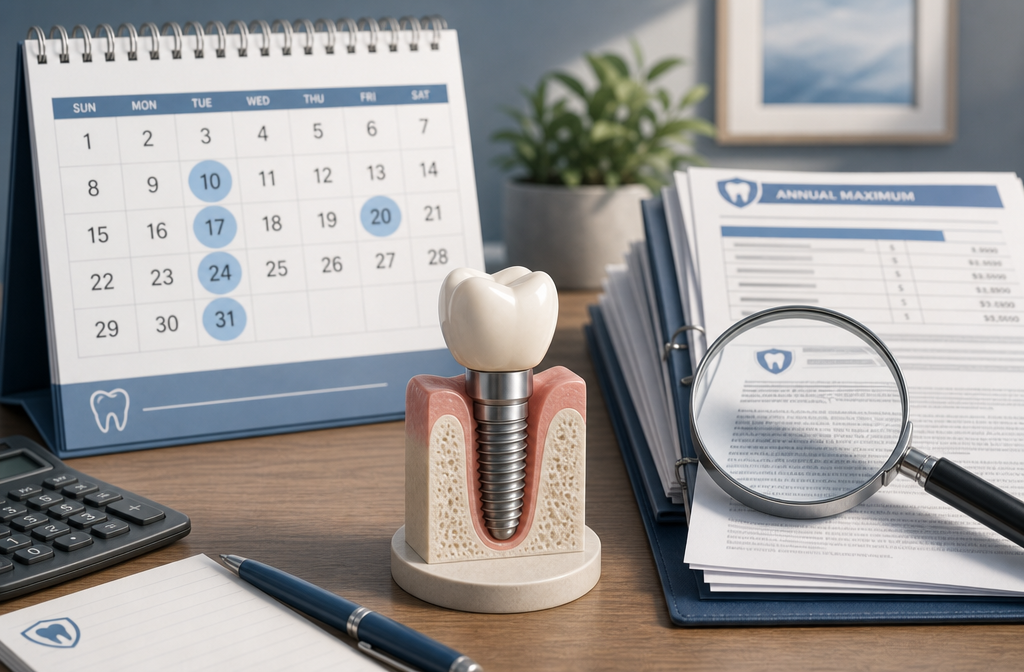
A waiting period is the time you must wait after your insurance coverage begins before you can receive benefits for certain procedures. For major restorative treatments like dental implants, waiting periods are common.
- Typical Waiting Periods for Implants: Most dental insurance plans impose a waiting period of 6 to 12 months for major services, including dental implant surgery. Some plans may even have a 24-month waiting period. This means if you enroll in a new plan in January 2026, you might not be able to use your benefits for dental implant placement until July 2026 or January 2027.
- Impact on Treatment Timeline: If you need an implant sooner, you may have to pay the full cost out of pocket or explore alternative financing options. It is essential to confirm specific waiting periods with your insurance provider before starting any part of the dental implant procedure.
Navigating Annual Maximums
The annual maximum is the highest amount a dental insurance plan will pay for your dental care within a benefit year. Once this limit is reached, you are responsible for 100% of any further costs until the next benefit year.
- Common Annual Maximums: For most dental insurance plans, annual maximums typically range from $1,000 to $2,500. Some premium plans may offer higher maximums, occasionally reaching $3,000 or $5,000, but these are less common and come with higher premiums.
- The Reality for Dental Implants: A single dental implant, including the post, abutment, and crown, can easily cost $3,000 to $6,000 in Dallas. Even with a plan covering 50% of the cost and an annual maximum of $1,500, your insurance would only pay $1,500, leaving a significant portion for you to cover. This is especially true for complex cases or multiple implants.
- Strategies for High Costs:
- Phased Treatment: If multiple implants are needed, some patients and dentists may stagger treatment across two benefit years to maximize insurance benefits. For example, the implant placement might occur in late 2026, and the crown placement in early 2027.
- Supplemental Insurance: Some individuals explore supplemental dental insurance or dental savings plans to help offset costs beyond the annual maximum.
- Flexible Spending Accounts (FSAs) and Health Savings Accounts (HSAs): If eligible, these accounts allow you to save and spend pre-tax dollars on qualified medical and dental expenses, including dental implants.
For those curious about the full financial picture, exploring “The ‘Hidden’ Costs of Dental Implants in Dallas: What to Expect” can provide further insights.
[[IMG_SLOT_2]]
Side-by-Side Comparison of Dental Insurance Coverage for Implants in Dallas 2026
To provide a clearer picture for residents seeking dental implants in Dallas 2026, let’s look at a comparative overview of how different insurance categories generally handle coverage, waiting periods, and annual maximums. This table illustrates typical scenarios; always verify specifics with your chosen provider.
| Feature | PPO Plans (e.g., Delta Dental PPO, Aetna PPO) | HMO Plans (e.g., MetLife DHMO, Cigna DHMO) | Dental Discount Plans (e.g., Aetna Dental Access, Cigna Dental Savings) |
|---|---|---|---|
| Implant Coverage | 30-70% of allowed amount (major procedures) | Limited to no coverage; fixed co-pays | 15-50% off network dentist’s fees |
| Waiting Period | 6-12 months (sometimes 24 months) | Often 0-6 months for basic, 6-12 for major | None (discounts available immediately) |
| Annual Maximum | $1,000 – $2,500 (can be higher for premium) | None (fixed co-pays or no coverage) | None (no “coverage” to max out) |
| Deductible | Yes, usually $50-$100 | No, typically co-pays per service | No, simply reduced rates |
| Provider Choice | Flexible (in-network saves money) | Restricted to network providers | Restricted to network providers (discount only applies there) |
| Pre-Auth Required? | Often recommended for major procedures | Sometimes for specialists (referral) | No |
| Out-of-Pocket (Single Implant) | $2,000 – $4,500 (after max/deductible) | $3,000 – $6,000 (near full cost) | $2,500 – $5,000 (after discount) |
| Out-of-Pocket (Full Arch) | $13,000 – $28,000+ (quickly hit max) | $15,000 – $30,000+ (near full cost) | $15,000 – $25,000+ (after discount) |
Note: These ranges are estimates for Dallas in 2026. Actual costs and coverage depend on the specific plan, provider, and individual treatment needs.
Key Takeaways from the Comparison
- PPO plans offer the best chance for significant financial assistance for dental implants, but their annual maximums mean a large portion of the cost will still be out-of-pocket, especially for multiple implants.
- HMO plans are generally not ideal for dental implant coverage. They may be suitable for routine care but fall short for extensive procedures.
- Dental discount plans can provide immediate savings without waiting periods or annual maximums, making them a viable option for those needing immediate treatment or who have already exhausted their insurance benefits.
When considering tooth replacement options, it is always recommended to have a thorough consultation with a dentist. They can provide an accurate treatment plan and estimate of costs. For discussions about different types of insurance and how they might apply to your specific needs, you may find our article on “Best Dental Insurance for Implants in Texas 2026: PPO vs HMO” helpful.
[[IMG_SLOT_3]]
Making an Informed Decision for Your Dental Implant Investment
Choosing the right dental insurance or payment strategy for dental implants in Dallas requires careful research and understanding of your specific needs. Since dental implants are a long-term investment in your oral health and quality of life, it’s essential to plan financially.
The Importance of Pre-Treatment Estimates
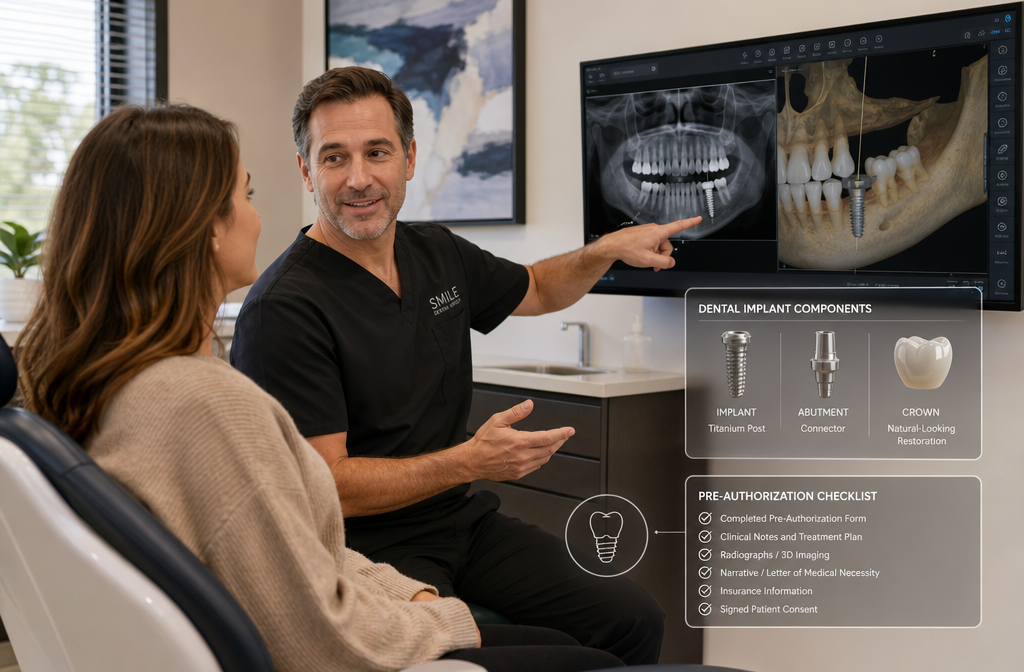
Before beginning any dental implant surgery process, always request a pre-treatment estimate from your dental office. This involves the dental office submitting your proposed treatment plan to your insurance company for a detailed breakdown of what they will cover and your estimated patient responsibility. This process clarifies:
- Exact Coverage: Which specific components of the dental implant procedure (e.g., extraction, bone graft, implant post, abutment, crown) are covered and at what percentage.
- Remaining Annual Maximum: How much of your annual maximum will be used and how much remains.
- Deductible Status: If your deductible has been met or how much you still owe.
- Waiting Period Confirmation: Confirmation that you have met any applicable waiting periods for major services.
This step helps avoid unexpected costs and ensures you are fully aware of your financial commitment.
Combining Strategies for Affordability
Many Dallas residents find that a combination of strategies works best to afford dental implants:
- Utilizing Insurance Benefits: Maximize your PPO benefits, especially if you can split treatment over two benefit years.
- Dental Savings Plans: Consider a dental discount plan to supplement insurance or as a primary option if insurance coverage is minimal or absent.
- Financing Options: Many dental offices offer in-house payment plans or work with third-party medical financing companies (e.g., CareCredit). These can break down the total cost into manageable monthly payments.
- Health Savings Accounts (HSAs) or Flexible Spending Accounts (FSAs): Use these tax-advantaged accounts to save for and pay for dental implant costs.
- Direct Communication with Your Dentist: Discuss your budget and financial concerns openly with your dental team. They can sometimes offer alternatives or suggest ways to phase treatment.
Understanding the initial cost, and potential “hidden” costs of dental implants in Dallas is crucial for long-term financial planning. This comprehensive approach supports informed decision-making and patient safety throughout your journey to restoring missing teeth solutions.
Conclusion
Navigating dental insurance plans for implants in Dallas 2026 can seem complex, but by understanding the nuances of coverage, waiting periods, and annual maximums, you can make more informed choices. PPO plans generally offer the most significant financial assistance, though annual maximums often necessitate considerable out-of-pocket spending. HMOs are typically less suitable for implant coverage, while dental discount plans provide an alternative for immediate savings.
The key to a successful and financially manageable dental implant experience lies in thorough research, proactive communication with your insurance provider and dental office, and strategic financial planning. Always seek a pre-treatment estimate and explore all available financing options. Your investment in dental implants in Dallas is an investment in your long-term oral health and confidence. A consultation with a qualified dentist in Dallas is the first and most important step to determine the best tooth replacement options for your individual needs.
SEO Meta Title: Dental Insurance for Implants Dallas 2026: Coverage, Waiting Periods & Maximums Compared SEO Meta Description: Compare dental insurance plans for implants in Dallas 2026. Understand coverage, waiting periods, and annual maximums side-by-side to plan your implant costs.